

We’d love to hear from you — whether you have a project in mind, or just want to say hello.
hello@awayo.co
.svg)
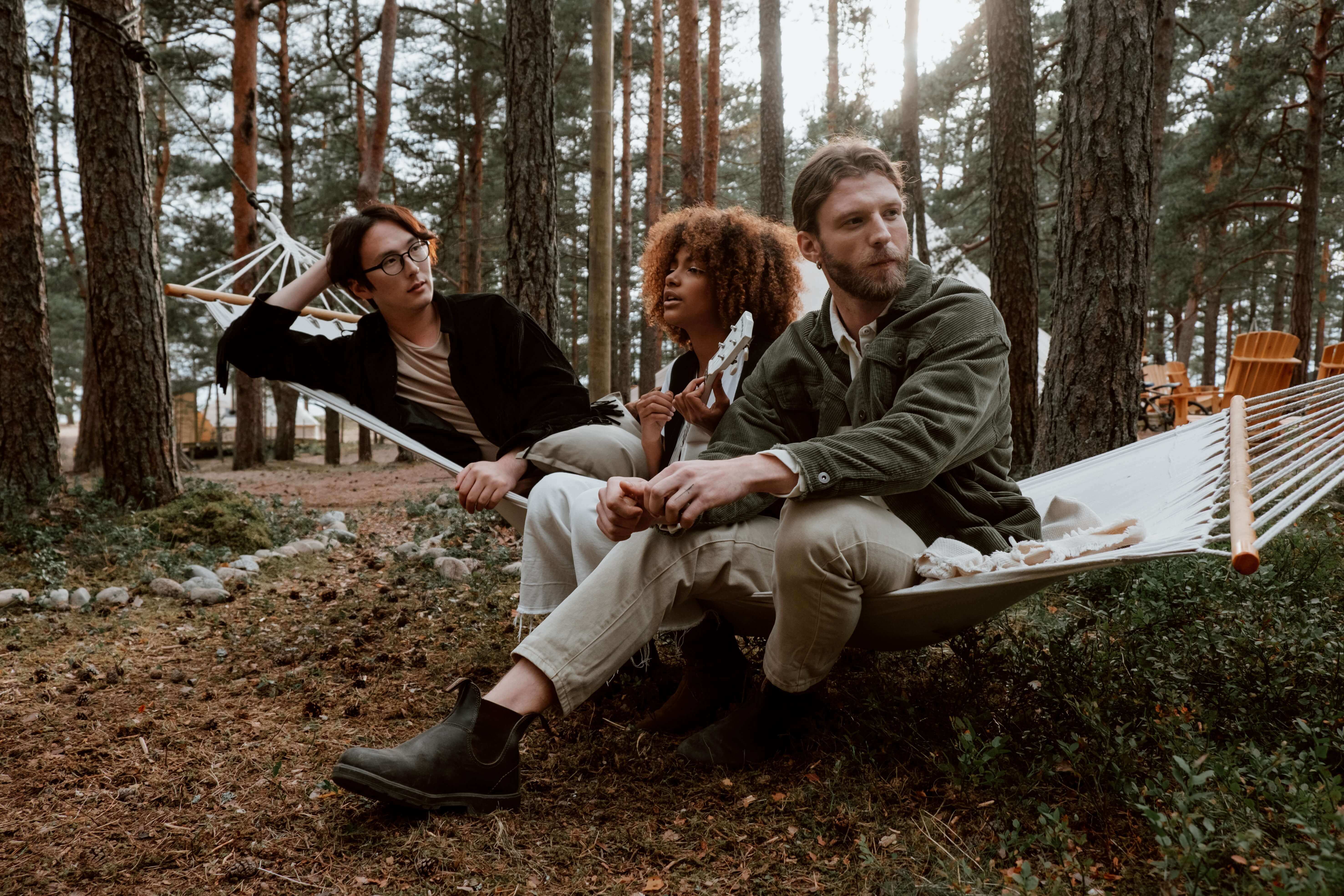
This is not a wellness trend. It is a structural condition of modern life — and it is reshaping why people travel, what they are looking for when they arrive, and why some properties generate fierce loyalty while others are booked once and forgotten.
Outdoor hospitality sits at the precise intersection of everything that solves it. The question is whether operators understand that yet.
The causes of modern disconnection are well documented. Remote work eliminated the daily micro-interactions — the coffee break, the shared commute, the incidental conversation — that anchored people to others without requiring effort. Geographic mobility broke the long-term friendships that took years to build. Social media replaced depth with reach. About two in ten US adults have no close friends outside of family — in 1990 only 3% said that. About one quarter of Americans say most people can be trusted, down from half in 1972.
The result is a generation of people who are, by every measurable standard, less connected than their parents — and acutely aware of it. Researchers and business observers are noting a trend they call "friction-maxxing" — a deliberate rejection of the frictionless, screen-mediated life in favour of real-world connection. People are actively seeking out experiences that require them to show up in person. In-person classes. Community events. Analog hobbies. And, increasingly, travel specifically chosen because it puts them in the same place as other people they might actually want to know.
This is not a niche behaviour. The need for connection is poised to be the defining trend of 2026 for the outdoor hospitality industry, according to Campspot's 2026 Travel Trend Report, which identifies the "Together-Trip" as the year's defining travel trend — with guests seeking shared experiences and community over solitude. The report frames camping itself as a cultural response to rising disconnection.
Every other hospitality format — city hotels, urban restaurants, airport lounges — sits within the environment that created the problem. The office building, the screen, the algorithmic feed, the transactional interaction: these are the textures of the city, and a city hotel cannot escape them no matter how good its spa.
Outdoor hospitality exists outside that environment by definition. The forest, the mountain, the river, the fell — these are places where the pace of human life slows to something closer to its natural rhythm. Conversations happen because there is nothing else competing for attention. Meals are shared because the communal fire is the obvious place to be. Strangers become recognisable because the site is small and the landscape is large.
This is not a feature that outdoor operators designed. It is a structural property of the product. But it is one that most operators have failed to design around intentionally — and the gap between the properties that do and those that don't is becoming one of the clearest differentiators in the market.
Guests increasingly want more than a place to visit. They want a place to belong. Community-focused programming, repeat-guest incentives, and social spaces that encourage interaction help turn first-time visitors into long-term fans.
There is a distinction that outdoor hospitality has not always made clearly enough. Solitude — chosen, restorative, deliberate quiet — is something many guests actively seek and are willing to pay a significant premium for. Isolation — the feeling of being alone without having chosen it — is what people are trying to escape.
The best outdoor hospitality properties deliver both at once. A private cabin with a hot tub and a view that cannot be replicated is, in itself, a solitude product. But when that cabin is part of a property where the communal sauna, the shared dinner table, the morning yoga class, or the guided walk create the conditions for connection without demanding it, something different happens. The guest gets quiet when they want it and company when they need it. That combination — private space within a social container — is extraordinarily rare in modern life, and extraordinarily difficult to find in any other hospitality format.
Jänkä Resort in Ylläs understands this instinctively. The thirteen villas are positioned for privacy and solitude. But the ranch adjacent to the property — where guests can brush a horse, feed a reindeer, sit by a fire in the company of animals and other people — creates the social layer that transforms a private stay into a shared experience. Guests do not have to interact. But the conditions for interaction exist, naturally and without pressure, in a way that a private villa in the middle of nowhere cannot offer.
The Barö in Finland operates on the same logic at a different scale. Eighteen cabins, each positioned for privacy and framing a specific view. But the sauna by the water, the restaurant terrace above the strait, the shared morning light on the cliff — these are the spaces where guests encounter one another without the social performance that urban settings demand. The barrier to conversation is lower because the setting removes the anxiety that normally surrounds it.
The hospitality industry has begun to measure this. Instead of focusing solely on average daily rate or suite size, more operators are tracking engagement with community events, repeat stays linked to neighbourhood loyalty, and qualitative feedback about belonging and emotional connection.
The commercial logic is not complicated. A guest who returns because the view was beautiful is making a rational decision that can be disrupted by a better view somewhere else. A guest who returns because of how they felt — the conversation at the fire, the walk with a stranger who became something more, the shared meal that lasted three hours — is making an emotional decision that is almost impossible to disrupt. In outdoor hospitality, guest behaviour features longer stays of three to seven nights and loyalty built on community and lifestyle rather than on points or programme mechanics.
This is the deepest form of brand loyalty available to an outdoor operator. It cannot be bought with a loyalty programme. It cannot be manufactured with a marketing campaign. It can only be created by designing the conditions under which connection becomes possible — and then getting out of the way.
The most desirable properties are those that make it easy to meet others with similar interests, participate in local culture, and feel part of a temporary community — what design research calls "scaffolded spontaneity." Not forced socialisation. Not programmed togetherness. Just the right physical arrangement, the right moments in the day, the right human-scale spaces that make conversation the path of least resistance.
The practical implications are more accessible than most operators assume.
The first is spatial design. Where do guests encounter one another naturally? The communal fire pit. The shared sauna. The breakfast room with one long table instead of six small ones. The narrow path between cabins that makes a nod unavoidable. These are not expensive interventions. They are design decisions that happen — or fail to happen — before the first guest arrives.
The second is programming that does not feel like programming. A guided morning walk is an invitation, not an obligation. A communal dinner on the second night of a stay — when guests have had time to arrive and settle — is a different proposition than one on the first. A seasonal activity rooted in the specific landscape — mushroom picking in autumn, snowshoe walks in January, a sauna ritual tied to the local calendar — gives guests a shared reference point that a generic experience cannot provide.
The third is curation of the guest community itself. The properties that generate the most powerful sense of belonging are rarely the ones with the broadest possible guest profile. Jänkä's thirteen-villa cap is not just an ecological choice. It is a community design choice: at that scale, guests become recognisable to one another. Noa Villas' adults-only positioning is not just a market segmentation decision. It is a statement about the kind of community the property is building and who belongs in it.
Research on spending patterns consistently shows that money spent on experiences — travel, concerts, classes — correlates with less loneliness than money spent on material goods. The outdoor hospitality property that understands itself as an antidote to disconnection — and designs itself accordingly — is selling something that no algorithmic platform, no urban hotel, and no Airbnb listing can replicate.
There is a version of outdoor hospitality that has always existed — and that is being rediscovered. The mountain refuge where hikers share a table at the end of a day. The campsite where families from three different countries find themselves around the same fire. The working ranch where guests are invited into the daily rhythm of a place and the people who keep it. These are not new ideas. They are very old ones, and they are becoming newly urgent.
The antidote to the frictionless, screen-mediated life is not more technology. It is real-world connection — the kind that requires showing up in person. Outdoor hospitality has been providing that, quietly, for generations. What is new is that the people who need it most — the urban professional working from home, the remote worker whose social infrastructure has dissolved, the couple who realised during the pandemic that they did not know their neighbours — are now actively looking for it.
The outdoor hospitality operators who understand this are not building amenity lists. They are building communities. And the guests who find them will come back — not because the cabin was beautiful, though it was, and not because the view was irreplaceable, though it was — but because of how they felt when they were there, and who they were with.
That is the most valuable amenity in outdoor hospitality. It always was. The market has simply caught up with what it is worth.
Sources
US Surgeon General's Advisory on the Healing Effects of Social Connection and Community, 2023 — hhs.gov
Science of People — Loneliness Statistics 2026 — scienceofpeople.com
Reach Out Recovery — The Loneliness Epidemic in 2026 — reachoutrecovery.com
Fortune — 25 years after "Bowling Alone," the loneliness epidemic is starker than ever, December 2025 — fortune.com
Campspot 2026 Travel Trend Report — "The Together-Trip" — via moderncampground.com
Northgate Resorts — The Future of Outdoor Hospitality in 2026 — northgateresorts.com
The Traveler — How Community Is Redefining Modern Luxury Travel, 2026 — thetraveler.org
BWDC — Hotelier's Guide to Outdoor Hospitality, 2025 — bwdc.com
Skift — How Travel Can Fix the World's Loneliness Crisis, 2024 — skift.com
BDNY 2025 — Redefining Hospitality for NextGen Guests — ariainc.com