

We’d love to hear from you — whether you have a project in mind, or just want to say hello.
hello@awayo.co
.svg)
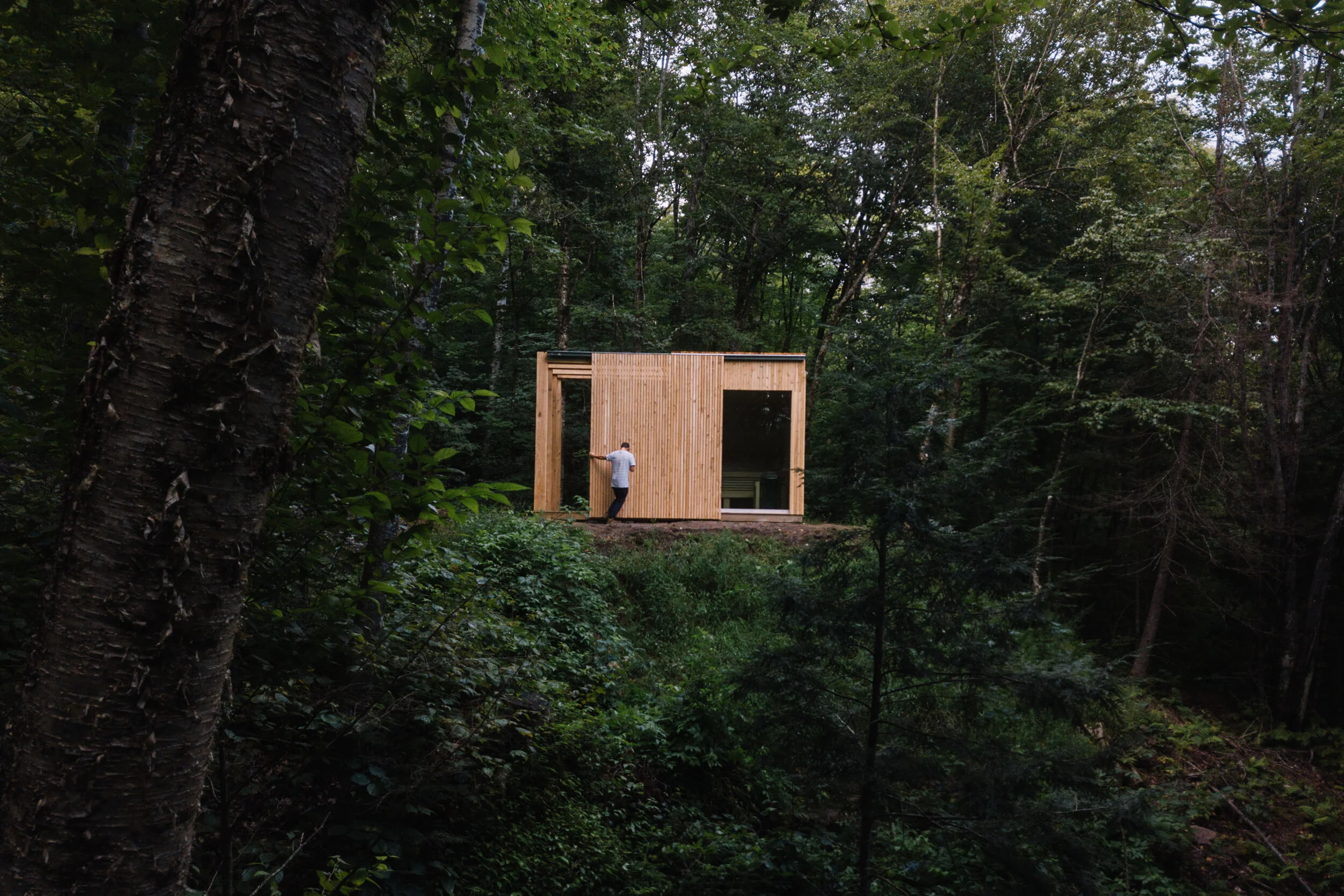
Mauricio Padilla and Emily Padan founded hinter in Montreal during the earliest days of the COVID-19 pandemic. At a moment when travel felt like an impossibility and Canada's borders were closed, they were already sketching the shape of what they wanted to build — not just an accommodation concept, but a vision of hospitality that operated entirely differently from anything else in the market.
Their first two properties — hintercabin and hinterhouse — were situated in the Laurentian Mountains northwest of Montreal, close to the ski destination of Mont-Tremblant. The region offered exactly what the founders were looking for: mountains, a high concentration of lakes, hiking trails, national parks, rivers, and the kind of four-season outdoor culture that makes a place worth building around. Both properties were positioned in the Laurentians, and both reflected the same design sensibility: architecturally considered, nature-immersed, carefully appointed, and operating as a direct rebuke to the cookie-cutter aesthetic of most outdoor accommodation.
Now it's moving to community building and sustainability. When you stay at a place, you can have way more than just that space — you can experience things. — Mauricio Padilla, Co-Founder, hinter
The most striking dimension of hinter's ambition is not the design of the properties — though they are genuinely beautiful — but the environmental goal they have set themselves. Most brands in the sustainability space aim for carbon neutrality: the point at which what you put into the atmosphere is balanced by what you offset or remove. hinter is aiming for carbon negativity. The aspiration is to build a hospitality company that actively removes more carbon from the atmosphere than it produces — not just a zero-sum proposition, but a net positive for the planet.
This is not simply a marketing position. It is embedded in the operational decisions of every property. hinter plants ten trees per booking through the global non-profit One Tree Planted, buffering the booking price to cover the $10 donation cost. The maths compound quickly: by the time of our research, hinter properties had supported the planting of approximately 6,000 trees. The founders describe this not as a charitable gesture but as a structural feature of the business model — something built into the price of a stay rather than bolted on as an optional extra.
The next phase of hinter's vision goes considerably further than two beautifully appointed cabins near a ski resort. Padilla and Padan have been searching for a large plot of land — 200 to 300 acres — on which to build what they describe as a community: 40 to 50 homes, hidden in the woods, designed not as a conventional resort but as a genuine place of belonging for the people who choose to stay there.
The vision includes permaculture farms, a library in the middle of the forest, a spa located somewhere else on the land, and a programme of events that supports local creatives and builds genuine connection between guests. The entire site would be owner-controlled, which is the crucial difference from the early hinter properties: when you own the entire lot, you can control what happens around the buildings, not just inside them. The character of the surroundings is no longer subject to the decisions of a third party.
This is a significant conceptual leap — from curated accommodation to intentional community. And it sits at the leading edge of where the most ambitious experiential hospitality concepts are moving: away from the single property and toward the owned ecosystem, where every element of the guest experience is part of a coherent, controlled world rather than a set of individual features.
One of the most considered aspects of hinter's approach is how it thinks about the relationship between its properties and the local economy around them. Rather than positioning a hinter stay as a retreat from the local area, the founders actively build local producers, makers, and experiences into the guest journey. Local artisanal food products are available for guests to purchase on their way to the property. The property website includes recommendations for the surrounding area — specific cafés, trails, restaurants, and producers — that treat the region as an extension of the hinter experience rather than a backdrop to it.
Small businesses and local producers are understood as collaborators in the guest experience, not just suppliers. This philosophy — that great hospitality deepens a guest's relationship with a place rather than isolating them from it — is something hinter shares with the best properties in this series. The distinction is that hinter has been unusually explicit about it as a founding principle, from the very beginning.
hinter is, in its current form, a small company: two properties in the Laurentians, a Montreal-based founding team, and a vision that has not yet been fully built. But it belongs in this series because of the clarity and ambition of what it is trying to do — and because the direction it is moving in represents one of the most interesting trajectories in experiential hospitality.
The move from sustainability as marketing to sustainability as structural business model. The move from single property to intentional community. The move from accommodation provider to ecosystem builder. These are the three transitions that define the most forward-thinking operators in this category — and hinter is pursuing all three simultaneously, from a standing start, in the Canadian wilderness.
All images are the property of their respective owners and are used for editorial and illustrative purposes only. Image rights belong to the featured brands and their designated photographers. AWAYO® makes no claim of ownership over third-party imagery.