

We’d love to hear from you — whether you have a project in mind, or just want to say hello.
hello@awayo.co
.svg)
That founding instinct is still the most important fact about The Barö. Everything else — the charred wood cabins, the lighting, the restaurant, the sauna — flows from it.
The Barö opened in June 2021, in the middle of a pandemic that had reshaped how people thought about travel, proximity to nature, and the value of quiet. Paavoseppä and Nieminen could not have planned for that context, but the product they had built was almost perfectly calibrated for it. Eighteen individually designed rooms — initially twelve, expanded in response to demand — arranged as separate wooden cabins on a cliff face above the Barösund strait, connected by elevated walkways that rest on stilts so as not to disturb the ground beneath them.
The timing was not the reason for the hotel's success. The design was.
The Barö is frequently described as a deconstructed hotel. The description is accurate. Rather than a central building with rooms attached, the property is a constellation of individual structures — each cabin its own self-contained space — clustered around a main building that houses the reception, The Berg restaurant, and the bar. Guests move between them along raised wooden walkways that treat the forest floor as something worth protecting.
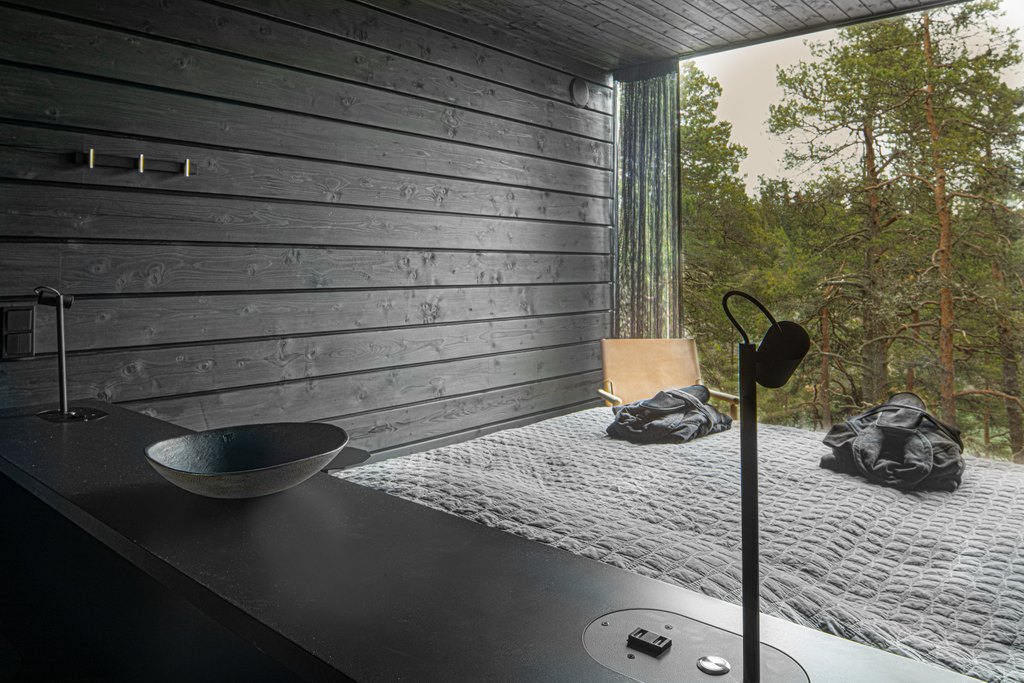
The exterior finish is charred wood. Black, textured, and alive in direct light in a way that smooth surfaces cannot replicate. Against the grey granite of the cliff and the dark green of the pines, the cabins do not announce themselves. They recede. At night, recessed lighting washes gently over the surfaces — designed by SAAS Instruments from the project's earliest stages — and the copper-framed floor-to-ceiling windows emit a warm glow that reads from the water like embers in the trees.
Inside, the cabins are deliberately dark. Dark tones, dark textiles, dark joinery. The reasoning is precise: when the interior is dim, the view through the full-height window becomes the room. The Barösund strait, the islands beyond, the winter ice, the summer boats moving slowly through the channel — these are the primary design element. Everything else is secondary.
The building materials reflect the same commitment to ecological honesty. Chemical-free solid wood construction, ecowool insulation, paper vapour barriers. Solar power for electricity. Groundwater from a borehole. On-site wastewater treatment. The hotel's stated ambition is to be climate neutral, and the construction method makes that a credible target rather than a marketing claim.
From a hospitality design perspective, the cabin configuration at The Barö solves several problems simultaneously — and does so in a way that most traditional hotels cannot.
Privacy is structural, not procedural. There is no question of guests hearing one another through shared walls, because there are no shared walls. Each cabin is a separate building. The sense of solitude this creates is the single most consistent theme in guest reviews — people repeatedly describe feeling as though they were the only ones on site, even when the hotel is at capacity.
The floor-to-ceiling window is not a feature; it is the architectural statement of the building. Every cabin is positioned to frame a specific view — forest, strait, or cliff — and the window is sized and placed to maximise that framing. The heated floors, premium bedding, bathrobes, and Finnish-designed ceramics are not incidental touches. They are the layers that allow the experience to function at a luxury price point without requiring the kind of spa and entertainment infrastructure that most luxury hotels depend on.
The complimentary minibar — soft drinks and snacks — is a small but telling detail. It communicates that the guest's comfort has been considered in advance. At The Barö, these signals accumulate into something that reads as genuine hospitality rather than service delivery.
Every boutique destination hotel faces the same food problem: guests are captive, but captive guests notice when food quality does not match the ambiance they are paying for. The Berg, The Barö's restaurant, serves Nordic cuisine with modern influences, using local produce and Finnish-sourced ingredients. Reviews are mixed — the breakfast is consistently praised, dinner divides opinion — but the intent is clear and the setting is exceptional. A large terrace above the strait, surrounded by pines, with the strait below and the islands beyond.
The restaurant is not the primary reason guests book The Barö. But it is the reason they stay on site for dinner rather than driving to the nearest town. That in itself is worth examining: the combination of location, design quality, and a credible F&B offer is sufficient to keep a guest oriented toward the property rather than away from it. For a 18-room boutique hotel with no pool and no conventional spa, that is a significant commercial achievement.
The Barö operates year-round — a decision that is more commercially significant than it might appear. The Finnish archipelago in summer is an obvious draw: sailing, canoeing, cycling, island-hopping, berry picking, the extraordinary Baltic light. But Paavoseppä and Nieminen built for winter too. The charred wood cabins in snow. The sauna lit against frozen water. The silence that arrives when the archipelago empties and the wildlife — deer, foxes, owls, white-tailed eagles — fills the space.
Winter guests at The Barö come specifically for the absence of what summer brings. They are a different segment, with different expectations, and the property serves them well because the core design value — immersion in the landscape — does not diminish in cold or darkness. If anything, it intensifies.
The proximity to Helsinki is the enabling factor for year-round viability. An hour by car is close enough for a weekend escape on impulse, but far enough to feel genuinely removed from the city. That catchment includes not just Finnish travellers but the significant number of international visitors who pass through Helsinki and are willing to extend their trip for something that cannot be replicated in an urban hotel.
The Barö opened with twelve cabins and expanded to eighteen within its first year — and there is reported appetite for further expansion. The manner in which that growth happens will be one of the most interesting strategic decisions the hotel faces.
The property's value is almost entirely a function of its restraint. The sense of quiet, the feeling of isolation, the impression that the landscape has not been disturbed — all of these are fragile. Add twenty cabins and the walkways become a thoroughfare. Add a spa block and the architecture loses its deconstructed logic. The challenge for The Barö, as for any boutique property that succeeds on atmosphere, is to grow revenue without growing the guest count to the point where the atmosphere deteriorates.
The answer, if there is one, lies in rate rather than volume. A property of this quality, in this location, one hour from a capital city, with a design pedigree that has attracted international attention, has room to push average nightly rates significantly above current levels. The ceiling for premium nature hospitality near Helsinki is not yet defined, and The Barö is better positioned than any other Finnish property to find it.
The Barö is a lesson in what happens when the founding instinct is correct and the execution is consistent. Paavoseppä's original vision — a hotel that respects its site, could be dismantled without leaving a trace, and allows guests to experience the landscape rather than simply be adjacent to it — has not drifted. Every design decision that followed from that vision is coherent with it.
That coherence is rarer than it should be. Most hospitality projects start with a strong concept and accumulate compromises as cost pressure, time pressure, and investor expectation reshape the brief. The Barö, built by founders who owned the vision and controlled the process, avoided that fate.
The result is a property that has grown from twelve to eighteen cabins, attracted international press coverage, and established itself as a reference point for what Nordic boutique hospitality can look like when it is done without apology. For operators thinking about how to build at the intersection of ecology, design, and genuine guest experience, it is required study.
All images are the property of their respective owners and are used for editorial and illustrative purposes only. Image rights belong to the featured brands and their designated photographers. AWAYO® makes no claim of ownership over third-party imagery.