

We’d love to hear from you — whether you have a project in mind, or just want to say hello.
hello@awayo.co
.svg)
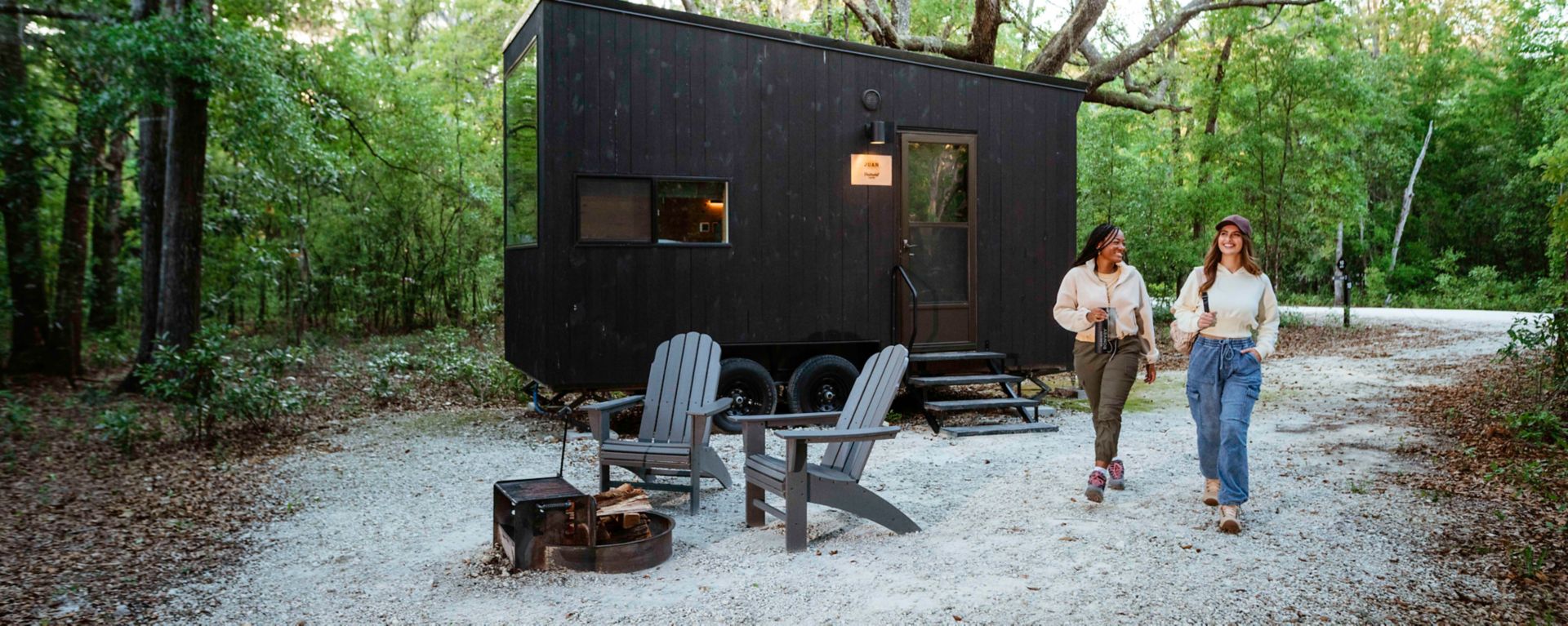
Jon Staff had been living in a 26-foot Airstream trailer for five months, travelling through the American West, when the idea first took shape. He had the space to reflect, realising how important a nature-city balance was to his emotional wellbeing. He called his college friend Pete Davis. Together, at Harvard's Innovation Lab, they sketched the concept of Getaway: a collection of tiny cabins, less than two hours from a major city, rented by the night, with no Wi-Fi. In July 2015, the first cabin — The Ovida — arrived in southern New Hampshire. Within months, there was a waitlist.
We just wanted a place to escape — somewhere quiet, without Wi-Fi. We discovered tiny houses and thought: if we put one in the woods outside the city, we'd have an easy place to go. That curiosity created Getaway. — Jon Staff
The cabins were tiny — 140 to 200 square feet — equipped with exactly what a person needed: a queen bed, a two-burner stove, a mini-fridge, a toilet, a hot shower, heat, air conditioning, a fire pit, outdoor seating, cookware, a mini-library, and — the detail that became the brand's most recognised signature — a wooden lockbox for your phone. The cabin was described as a piece of hardware for accessing nature, not the attraction in itself. Wi-Fi was absent by design. The exact location was not revealed until shortly before check-in.
Staff was direct about the framing. He described the experience as not being about the cabin or even the destination — it was about you, in the woods, with the person or people you cared about, with nowhere else to be. This is what made the product commercially powerful from the beginning: it was selling the absence of things. And the absence of things turned out to be exactly what the market needed.
Getaway raised $1.4 million in seed funding at launch in 2015. In February 2017, Staff and Davis appeared on Shark Tank — pitching $500,000 for a 5% stake, implying a $10 million valuation. They declined all offers, including Chris Sacca's offer valuing the company at $7 million. The day after the Shark Tank episode aired, Getaway's website received over 100,000 visitors — up from its normal 1,000 to 3,300 per day. All available cabins sold out for the summer within hours of broadcast.
In June 2019, Starwood Capital Group led a $22.5 million Series B, joined by L Catterton. By this point, Getaway had six Outposts with 140 cabins. In 2020, year-on-year bookings increased 150%. Occupancy across all Outposts ran at nearly 100%. In February 2021, Getaway announced a $41.7 million Series C led by Certares. Total funding had reached $81 million. By May 2022, Getaway crossed 1,000 cabins. By August 2023, 29 Outposts were operating. Annual revenue had grown to $41 million. Over 2 million guests had spent more than 40 million hours in nature at Getaway properties.
In October 2024, Getaway officially rebranded as Postcard Cabins. Two months later, in December 2024, Marriott International acquired the brand. Goldman Sachs served as exclusive financial advisor. Postcard Cabins joined the Marriott Bonvoy Outdoor Collection — bookable through the Marriott app, earnable with Bonvoy points. Total funding raised: approximately $94 million across 22 investors including L Catterton, Starwood Capital, Certares, Alpaca VC, Alumni Ventures, and Benevolent Capital.
The most durable businesses in hospitality are the ones that solve a real problem for a real person. Getaway solved the problem of wanting to be in nature without surrendering comfort — for millions of people who had given up on camping as a result. The cabins were always the hardware. The mission was always the product. And the mission proved to be worth a great deal more than a hardware company ever would have been.
All images are the property of their respective owners and are used for editorial and illustrative purposes only. Image rights belong to the featured brands and their designated photographers. AWAYO® makes no claim of ownership over third-party imagery.