

We’d love to hear from you — whether you have a project in mind, or just want to say hello.
hello@awayo.co
.svg)
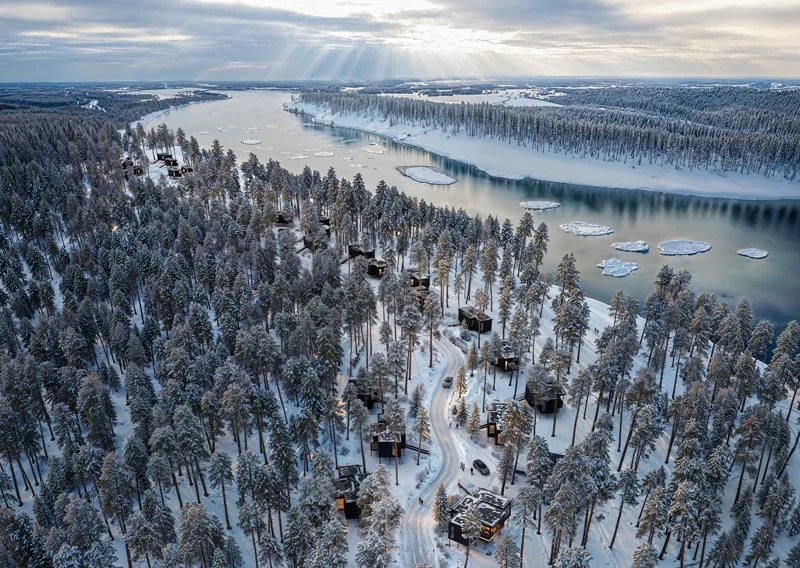
In the case of Noa Villas, it appears to be both.
Noa Villas is the result of a collaboration between two organisations with distinct but complementary expertise. Studio Puisto, the Helsinki-based architecture and interior design firm, brought the design language and ecological discipline. Lunvio, an international hospitality and real estate developer focused on nature-immersive retreats across Europe, brought the development framework, capital structure, and operating model.
The combination matters. Studio Puisto's reputation in outdoor hospitality architecture is well established — their portfolio includes the Arctic TreeHouse Hotel in Rovaniemi, the Uni Villas at Kytäjä Golf, and a body of work defined by the principle that buildings should adapt to their sites, not the other way around. Lunvio's role is less visible from the guest perspective, but structurally critical: it is the developer that makes the financial case work, manages the construction process, and creates the conditions under which a project like Noa Villas can actually be built at this quality level.
Together, the two organisations have produced a resort that reads as fully formed — not as a work in progress or a concept under development, but as a complete, intentional hospitality product.
Noa Villas is located near Sodankylä in Finnish Lapland, on a 14-hectare riverfront estate along the Kitinen river. The surrounding landscape is classic northern Finnish wilderness — pine forest, river, open sky — in one of Lapland's most active aurora zones. Light pollution is minimal. Dark, clear nights are the norm for much of the year.
The adults-only positioning is a deliberate market decision. In a landscape saturated with family-friendly Lapland packages — husky safaris, Santa experiences, child-oriented aurora tours — Noa Villas carved out a specific guest profile: couples seeking quiet, privacy, and a high-quality experience without the infrastructure of a large resort. No children. No group dynamics. No noise.
This is a commercially astute choice. The couples' travel segment consistently demonstrates higher average spend, lower price sensitivity, and stronger repeat intent than family travellers. An adults-only property in Lapland also differentiates itself immediately in search and booking platforms, where the category designation functions as a filter that surfaces the property to exactly the guests it is designed for.
Noa Villas offers 32 units across three configurations, all designed by Studio Puisto and all adults-only.
The Deluxe Villa, at 57m² plus a 28m² terrace, is the flagship product. Private panoramic sauna, outdoor jacuzzi, floor-to-ceiling windows framing river and forest views. The specification is deliberately premium — not because luxury is the category, but because the guest experience requires it. A jacuzzi in the snow under the northern lights is not an amenity. It is the reason someone books.
The Superior Villa, at 50m², pairs a private outdoor jacuzzi with Scandinavian interior design and panoramic glass walls. The lounge and bedroom are framed by the window rather than separated from it. The Standard Villa maintains the same footprint and glass-wall approach at a lower price point, with a smaller terrace and no private sauna — but with the same design language, the same material quality, and the same relationship to the landscape. A wheelchair-accessible Standard Villa configuration extends the product to guests who are rarely considered in outdoor hospitality design.
The design principle across all three types is consistent: natural materials, warm wood, soft textiles, and floor-to-ceiling glazing that makes the forest or river the primary feature of every room. Interiors are deliberately calm — nothing competes with the view. The architecture becomes a frame, not a statement.
Noa Villas has understood something that many boutique nature retreats struggle with: the accommodation alone is not enough. Guests who travel to Lapland specifically for a quiet, adults-only experience still need programming — but programming that does not feel like a packaged tour.
The solution is curated arctic packages that combine the stay with carefully selected Lapland experiences: snowmobile tours, husky excursions, reindeer encounters, and traditional sauna rituals. These are not offered as bolt-on extras after booking. They are integrated into the stay from the point of purchase, reducing friction and ensuring guests arrive with their time already structured.
The Sauna Village — a shared riverside sauna facility available to all guests — provides a social anchor for the property without requiring the construction of a full spa or wellness centre. It is a distinctly Finnish solution: simple, honest, effective. Warm wood, hot steam, cold river, open sky.
Nordic cuisine is positioned as a deliberate component of the guest experience, with local produce and seasonal ingredients framed not as restaurant marketing but as an extension of the resort's relationship to its place.
"Quiet luxury" is a term that has been used extensively in fashion and retail since 2023, but its application to hospitality is still finding definition. In most cases it means something close to: premium quality without visible branding, restraint over ostentation, materials over logos, atmosphere over spectacle.
Noa Villas makes a credible case for the concept in a hospitality context. The design language is consistent with it — no maximalism, no theatrical gestures, no signature piece that announces itself. The positioning is consistent with it — no children, no groups, no programme unless requested. The marketing is consistent with it — the photography is quiet, the copy is spare, the aesthetic is deliberately understated.
Whether "the first quiet luxury nature resort in Lapland" is a verifiable claim is almost beside the point. The phrase communicates a positioning with precision, and the product delivers enough on that positioning to justify it.
Lunvio deserves separate attention as a developer, because the model it represents is increasingly relevant to how premium outdoor hospitality gets built.
Lunvio is not an operator in the traditional sense — it is a developer that creates the conditions for a resort like Noa Villas to exist, then works with architecture and design partners to bring a specific vision to life. The firm describes itself as focused on "refined, nature-immersive retreats across Europe," which positions it as a specialist developer in a category that most general real estate developers do not understand well enough to execute at quality.
The collaboration with Studio Puisto is the proof of that positioning. Studio Puisto does not work with developers who do not share their ecological and design values — and the quality of Noa Villas reflects the fact that both parties were aligned on what the product needed to be before a single unit was built.
This model — specialist developer plus architecture firm with shared values, producing a property at boutique scale for a defined guest segment — is one of the more compelling structural arguments in outdoor hospitality right now. It avoids the compromises that occur when a developer hires an architect as a service provider, and it avoids the funding constraints that occur when an architect tries to develop independently.
Noa Villas is interesting to us for two reasons.
The first is the adults-only positioning in a market that has not made that choice loudly. Lapland as a destination is associated with families and Christmas tourism. Noa Villas is betting that a significant segment of high-value travellers has been underserved by that association — and the evidence, from booking platform listings to early guest reviews, suggests they are right.
The second is the developer-architect model. Lunvio and Studio Puisto have built something that neither could have built alone. The developer without the architecture firm would have produced something competent but generic. The architecture firm without the developer would have produced a concept that never reached full scale. Together they have produced a 32-villa adults-only resort in Lapland that is coherent, finished, and commercially viable.
That is the model that outdoor hospitality needs more of. And Noa Villas is one of the clearest current examples of it working.
All images are the property of their respective owners and are used for editorial and illustrative purposes only. Image rights belong to the featured brands and their designated photographers. AWAYO® makes no claim of ownership over third-party imagery.