

We’d love to hear from you — whether you have a project in mind, or just want to say hello.
hello@awayo.co
.svg)
That is not the standard origin story for a premium Lapland property. And it produces a product that is, in several important ways, not standard.
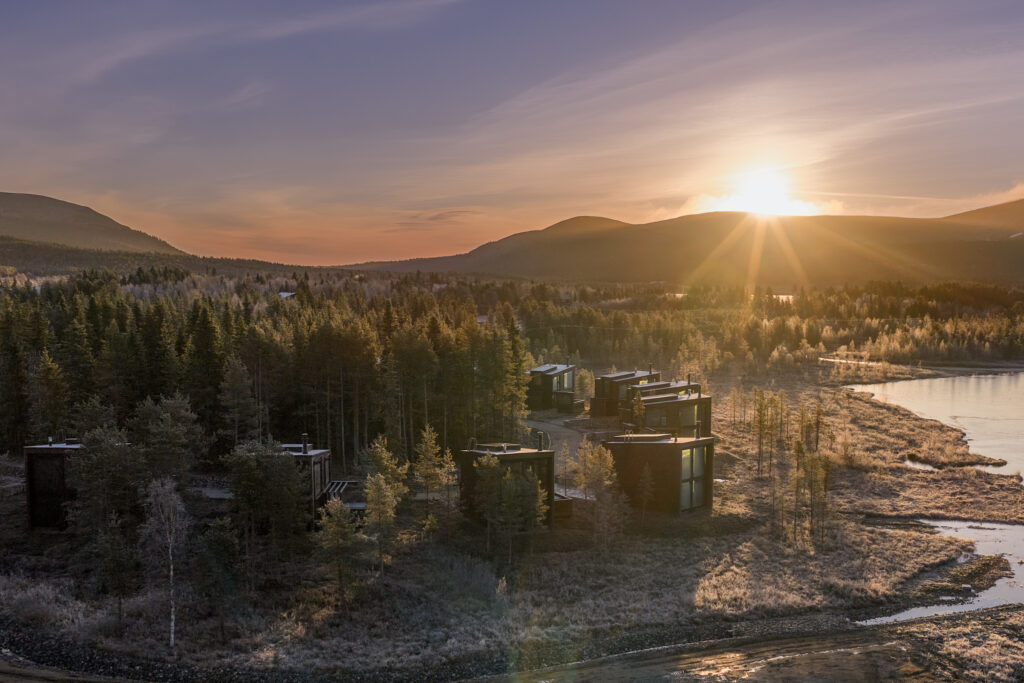
Jänkä operates across two distinct formats. The flagship is Jänkä Resort & Ranch in Ylläs, a 13-villa property set in the wilderness 45 minutes from Kittilä airport, adjacent to a working ranch with horses, reindeer, and huskies. The second is Jänkä Downtown Levi, two premium urban apartments — a Penthouse of 300m² for up to 10 guests and a Townhouse for 8 — located one minute's walk from the ski lifts in the centre of Levi, Finland's most popular ski resort.
The two formats serve different guest profiles with the same brand values: privacy, quality, and a connection to authentic Lapland. The Resort serves guests seeking wilderness immersion. The Downtown serves guests who want ski access and village proximity without sacrificing design quality or privacy. Together they cover the most commercially significant segments of the premium Lapland market without a single property needing to do both.
The 13 villas at Jänkä Resort Ylläs were completed for the Christmas 2025 season, built by Polar Life Haus, a Finnish manufacturer specialising in premium log construction. The choice of builder is architecturally significant. Log structures provide natural thermal mass — particularly valuable in an environment where temperatures regularly reach -35°C — and the aesthetic is consistent with the Lapland landscape in a way that engineered timber or steel frame construction is not.
The resort carries a total project budget of €6,699,610, of which €1,339,922 is co-funded by the European Union — a detail that Jänkä makes public rather than obscuring. EU co-funding for high-end tourism infrastructure is not unusual in Finnish Lapland, where regional development policy recognises premium tourism as a driver of sustainable economic growth in remote communities. The transparency is notable: most premium hospitality operations prefer not to discuss their financing publicly. Jänkä's willingness to do so reflects the confidence of a local family business rather than the reticence of an anonymous investment vehicle.
The 13 villas are arranged across four view categories — lake, forest, fell, and ranch — with each unit positioned to ensure an unrestricted, unique outlook. At maximum capacity the resort holds 52 guests. At that occupancy level, the founders note, there are likely more animals on the ranch than people in the villas. That ratio is not accidental.
Jänkä has taken an explicit stance on over-tourism that is unusual for a commercial hospitality operation. The resort describes itself as "dedicated to promoting sustainable economic growth by preventing over-tourism." The 13-villa cap is not a phased opening pending future expansion. It is a deliberate limit.
This is a positioning decision as much as an ethical one. In a Lapland market where glass igloo resorts have scaled to hundreds of units and husky safari operators process thousands of visitors per season, a property that caps at 52 guests occupies a fundamentally different market position. Scarcity is the product. The guest who books Jänkä is not buying a Lapland experience that happens to be premium. They are buying an experience that is specifically calibrated to feel private, unhurried, and uncontaminated by mass tourism.
The commercial logic holds: a smaller property with a higher average nightly rate and strong repeat intent generates revenue that can be sustained indefinitely, without the operational complexity and community impact that large-scale tourism creates. The founders are Lapland locals. They live with the consequences of tourism decisions in a way that absentee investors do not.
Most premium Lapland properties offer animal experiences as add-ons — a husky safari booked through a third-party operator, a reindeer sleigh ride as part of a package. At Jänkä, the ranch is part of the property. Horses, reindeer, and huskies live on the land adjacent to the villas, and guests interact with them not as a scheduled activity but as a dimension of the stay itself.
The philosophy behind this is worth examining. The ranch team describes their approach as built on "trust and respect" — animals as partners rather than attractions. Guests are invited to participate in daily care: brushing, feeding, quiet presence. There is no requirement to ride or drive. The experience is explicitly not about performance or spectacle. It is about contact — the kind of unhurried, mutual engagement that is increasingly rare in commercial tourism and that a guest paying premium rates for a wilderness experience is precisely seeking.
The guided ranch visit — at €59 per adult and €39 per child — runs for 1.5 to 2 hours. It concludes by a fire with warm juice and roasted marshmallows. The pricing is modest relative to the overall cost of a stay, which suggests the ranch is not positioned as a revenue centre but as a retention mechanism: the reason guests feel they experienced something real rather than something staged.
This distinction matters for repeat bookings. Lapland has no shortage of packaged experiences. It has very few experiences that guests describe as genuinely memorable in the way that Jänkä's ranch consistently appears in reviews.
Jänkä operates its own restaurant at the Ylläs property, which is open to both hotel guests and external visitors. The kitchen is led by a head chef offering a five-course set menu on select evenings — a format that creates a premium F&B moment within the stay without requiring the overhead of a full à la carte operation.
Early reviews on the restaurant are mixed on execution — a new team finding its rhythm in a recently opened property — but consistent on intention. The food philosophy follows the same principles as the accommodation: local sourcing, seasonal ingredients, an emphasis on Lapland's larder of wild herbs, berries, fish, and game. The restaurant does not try to import a cosmopolitan fine dining identity into the wilderness. It tries to serve the place it is in.
The head chef's five-course menu, available on specific evenings, functions as an anchor for the guest experience on those nights — giving guests a reason to stay on property for dinner rather than driving to Äkäslompolo village.
The Levi properties — Penthouse and Townhouse — are a structurally different product from the resort, and their inclusion in the Jänkä brand is commercially intelligent. Levi is Finland's largest ski resort and one of the most internationally recognised destinations in Finnish Lapland. It hosts the Alpine Skiing World Cup and attracts a high-spending European clientele that is distinct from the wilderness-seekers drawn to Ylläs.
The Penthouse at 300m² is one of the largest private accommodation units available in Levi — a direct ski-in, ski-out property with panoramic fell views, a rooftop configuration, and premium interiors that match the resort's design standard. The Townhouse sits adjacent, extending the capacity for larger groups while maintaining the same quality level.
Both properties are a 15-minute drive from Kittilä airport. For a guest arriving from Helsinki or an international connection, this makes Jänkä Downtown the most accessible premium option in the Levi market.
The two-location model allows Jänkä to cross-sell across its own portfolio: a guest who stays at the Downtown in winter may be directed to the Ranch for a summer visit. A guest who discovers the Ranch through word of mouth may add a Levi skiing week through the Downtown. The brand coherence — same values, same quality, same Lapland authenticity — makes the referral credible.
Jänkä is interesting to us for a reason that has nothing to do with scale. It is a family-owned, locally-rooted business that has built a premium product without losing the thing that premium nature hospitality most frequently loses: genuine connection to place.
The anti-overcrowding commitment is not marketing. The founders live in Äkäslompolo. The land has been in the family for decades. The ranch animals are part of daily life before they are part of a guest experience. These are not positioning decisions made in a boardroom. They are the natural expressions of a specific relationship to a specific landscape.
That authenticity is detectable. It shows up in guest reviews in a particular way — not as praise for amenities or facilities, but as the kind of language people use when they feel they have been somewhere rather than visited something. That distinction is the hardest thing to manufacture in outdoor hospitality, and the easiest thing to lose when growth becomes the primary objective.
Jänkä has chosen a ceiling. Thirteen villas. Fifty-two guests maximum. More reindeer than people. For the right guest, that is not a limitation. It is the product.