

We’d love to hear from you — whether you have a project in mind, or just want to say hello.
hello@awayo.co
.svg)
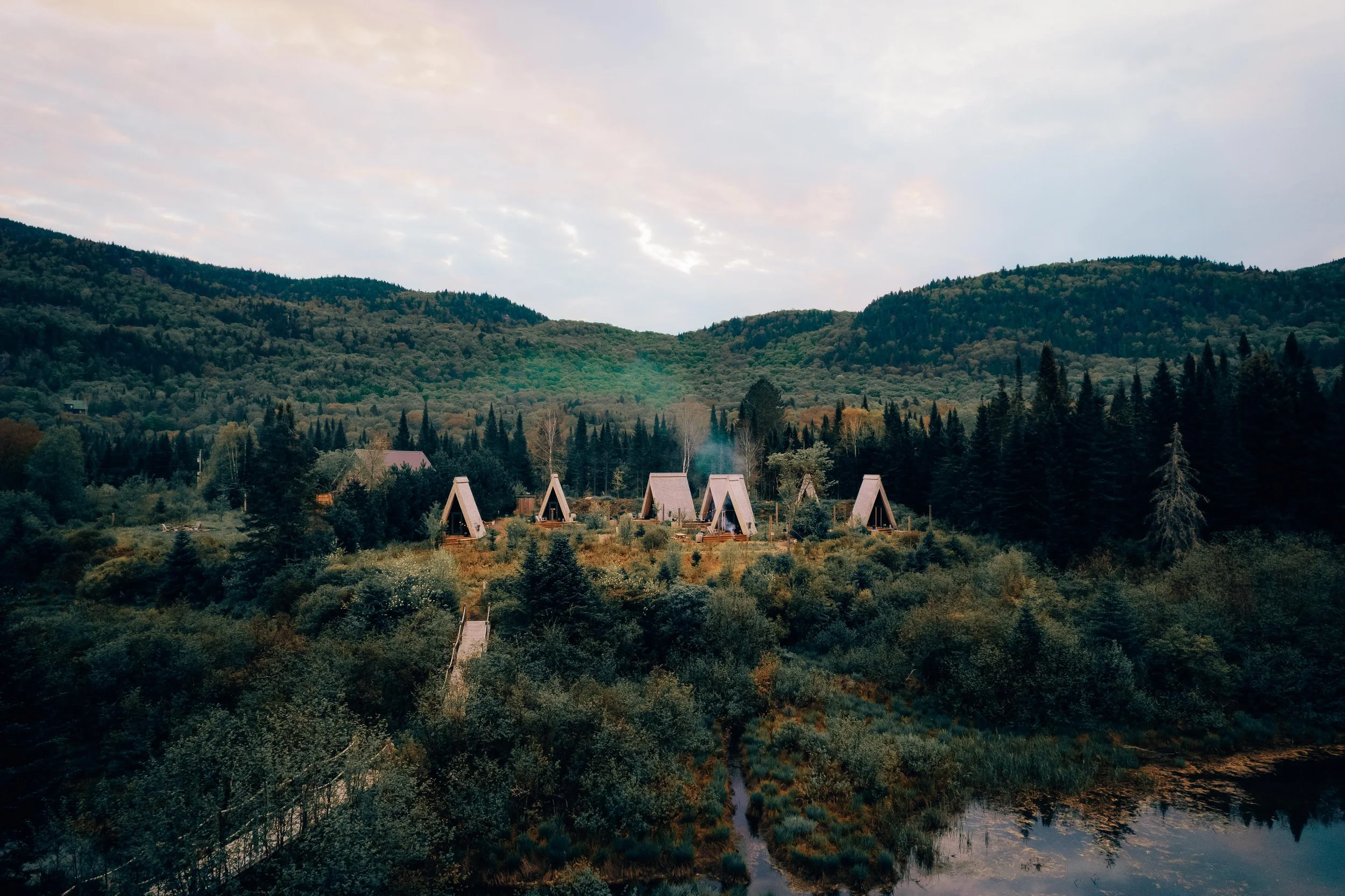
Jonathan Casaubon and Geneviève Côté opened Farouche in July 2022 on a sliver of their 100-acre wooded property in the Laurentian Mountains of Quebec, Canada — at the base of a ski resort in Mont-Tremblant, approximately 90 minutes north of Montreal. The name itself sets the tone: farouche is a French word meaning wild, untamed, or fiercely independent. It is a character description of the landscape and, implicitly, of the philosophy of the people who built it.
The property consists of seven micro-cabins — architecturally designed nature shelters, each connected by footpaths to the outdoor centre with hot tub and the main lodge with bathrooms and a farm bar. Across the road from the accommodation sits the Nordic farm where, during the summer months, Casaubon and Côté stay busy growing cabbage, beets, carrots, and other produce to feed their guests. The farm is not decorative. It is operational, and the produce it generates forms the basis of the food offer at Farouche. This is agri-tourism in its most literal and committed form: the land feeds the guests, and the guests support the land.
A gas fireplace clicks on in the cold morning. The coffee maker is nearby. The temperature outside hovers near negative 10°F. This is exactly the kind of simple luxury Farouche was built to deliver — the warmth of a well-made space in the middle of something wild.
The seven cabins at Farouche are each named in the tradition of French-Canadian culture — La Tuque, for example, is named after the French-Canadian word for a winter hat. They are micro-cabins: small, architecturally refined, designed to do the essential things very well and to leave the surrounding landscape room to do everything else.
Each cabin is a gas-heated shelter with a gas fireplace, a quality bed, a coffee station, and the kind of compact, considered design that makes small spaces feel intentional rather than cramped. The footpaths that connect the cabins to the lodge pass through a landscape that changes entirely with the seasons: deep snow and dark pines in winter; lush forest, a small beach, and a river in summer. The ski resort at the base of which Farouche sits is accessible in winter; in summer, the same terrain becomes a hiking and cycling destination.
The hot tub at the outdoor centre is open year-round — which, at Farouche, is not a luxury extra but a genuine necessity for guests arriving from a day on the mountain in January. The lodge itself serves as both the social heart of the property and the home of the farm bar, where locally produced ingredients and the farm's own vegetables are turned into food and drink that extend the farm-to-table logic into every part of the guest experience.
The farm bar at Farouche is perhaps the most distinctive single element of the concept. It is not a restaurant in the conventional sense — it does not have a full kitchen brigade or a formal dining room. It is a bar and kitchen that serves simple, high-quality food built around local and farm-grown ingredients, served in a convivial atmosphere that encourages guests to linger, to talk to each other, and to engage with the environment around them.
The food philosophy follows the logic of the Nordic farm directly: whatever is in season on the land is what is on the plate. In summer, that means the vegetables Casaubon and Côté have grown across the road. In winter, it means preserved and stored produce, supplemented by local suppliers who share the same commitment to provenance. The result is a food offer that is both deeply specific to this place and deeply honest about the constraints of operating in a northern agricultural climate — and that honesty is precisely what makes it compelling.
Farouche is a seven-cabin retreat on a family farm in Quebec. By the metrics of scale, it is among the smallest concepts in this series. By the metrics of coherence and honesty, it is among the most instructive. Everything at Farouche serves a single idea: that the best hospitality is grounded in the specific character of a specific place, built by people who know and love that place, and sustained by a direct relationship between the land and the people who stay on it.
The farm-to-cabin model that Farouche demonstrates is not just a food trend. It is a structural hospitality philosophy — one that aligns the economic interests of the operator, the environmental health of the land, and the experiential quality of the guest stay into a single, self-reinforcing system. The farm generates the food. The food defines the character of the stay. The stay funds the farm. And the whole system gets stronger with every season.
All images are the property of their respective owners and are used for editorial and illustrative purposes only. Image rights belong to the featured brands and their designated photographers. AWAYO® makes no claim of ownership over third-party imagery.