

We’d love to hear from you — whether you have a project in mind, or just want to say hello.
hello@awayo.co
.svg)
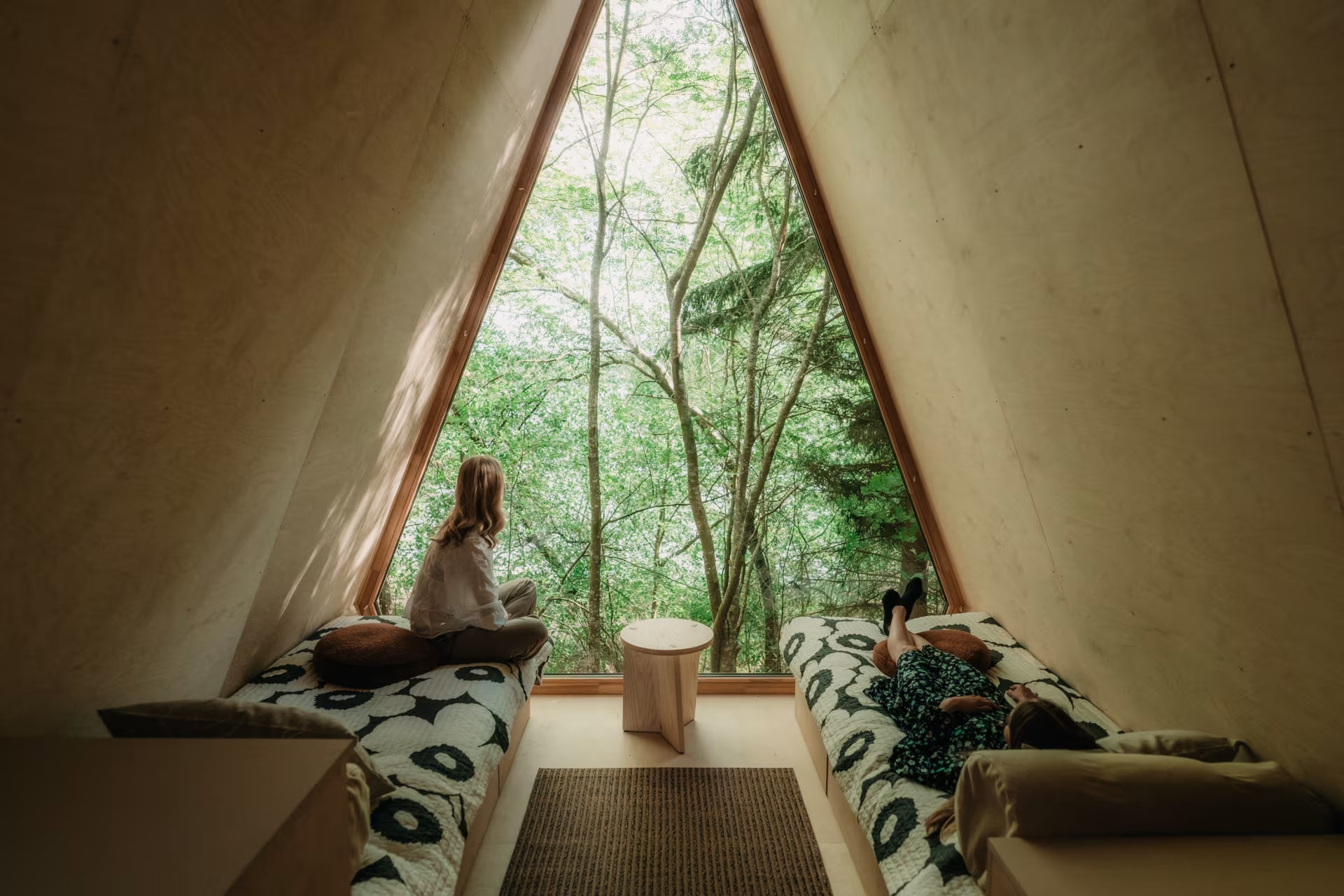
In the summer of 2018, a nine square metre A-frame cabin appeared on Vallisaari — a tiny, nearly pristine island in the Helsinki archipelago, a twenty-minute boat ride from the city centre. The island was home to hundreds of plant and animal species, including over a thousand butterfly species, and had been in a near-natural state for decades after serving as a restricted military zone.
The cabin had solar panels on the roof, a small cooking nook with a Wallas stove running on renewable diesel, two camping beds, linen sheets, towels, natural cosmetics, and a small library. It did not have a bathroom. It did not have Wi-Fi. It did not have running water. It was immediately, completely, fully booked. The cabin was called Nolla — the Finnish word for zero. It was designed by Robin Falck, a Finnish designer trained at Aalto University, commissioned by renewable energy company Neste as part of their Journey to Zero initiative.
I wanted to achieve the same feeling you get when you open the zipper of your tent as you wake up in the morning. One direction. Pointing towards the most beautiful view. That was the entire design ambition. — Robin Falck
The form — a sharp A-frame in local pine and plywood — was chosen for three reasons simultaneously: structural efficiency using minimal material; visual resemblance to a tent, intentionally framing the stay as camping-adjacent; and instant recognisability. The sides of the roof include mirror panels that deflect heat. One end is entirely glass, delivering what Falck describes as the tent-opening experience each morning.
The structural system is remarkable: every component is replicable from standard timber by anyone with basic woodworking skills. The pieces slot together without screws — assembled like a large puzzle. Eight extendable wooden legs adjust to accommodate any terrain. No foundations. No concrete. No construction permit required. It leaves almost no trace on the land it occupies. The cabin was designed as cradle-to-cradle: repairable, movable, and endlessly re-purposable.
Solar panels on the roof generate electricity. The Wallas stove and heater run on Neste MY Renewable Diesel, produced entirely from waste and residue, reducing greenhouse gas emissions by up to 90% versus fossil fuel alternatives. The boat running between Helsinki and Vallisaari was also switched to the same fuel — making the entire journey to and from the cabin part of the same zero-emissions system. The decision to work without running water was not a failure of comfort. It was a deliberate philosophical choice: the cabin should make its own environmental constraints visible rather than hiding them behind infrastructure. Profits from the original Vallisaari cabin were donated to The Ocean Cleanup.
Nolla Company has used the cabin's mobility to build a portfolio impossible for a fixed-structure brand to replicate: Tvijälp in Espoo (seven cabins), Vasikkasaari in Helsinki (five cabins), Viikinsaari in Tampere (five cabins), Rantapuisto in Helsinki (one cabin), and Akaa (three cabins) — all in Finland. Plus Yosemite in California (three cabins) and Santa Cruz in California (one cabin). And the NOLLA x Partioaitta collaboration cabin in Espoo.
The Marimekko Nolla — the world's only Marimekko-branded cabin — demonstrates the partnership model: Nolla Company provides the cabin and sustainability credentials; Marimekko provides design authority and an internationally minded guest profile. The Become a Nolla Entrepreneur pathway extends the model to landowners who want to add cabins to their sites — franchise logic applied to micro-architecture.
Beyond the cabins themselves, Nolla has built a curated experiences programme: yoga retreats on deserted islands, island survival courses, kayaking, nature walks, guided mushrooming and berry-picking, murder mystery evenings, archipelago cruises, and wilderness skills workshops. This moves Nolla out of the narrow category of eco-accommodation and into the broader experiential hospitality market, where the cabin is the anchor but the programme is the reason to book more than one night.
Nolla Cabins is the smallest brand in this Best Practice Series by every conventional metric. And yet the lesson it carries is one of the most transferable. A product so honest, so coherent, and so precisely designed that the story tells itself. The cabin was the press release. The experience was the review. And the design — ten square metres of Finnish pine, adjustable wooden legs, a glass wall facing the water — was good enough to cross borders, oceans, and cultural contexts and arrive in California still making complete sense.
All images are the property of their respective owners and are used for editorial and illustrative purposes only. Image rights belong to the featured brands and their designated photographers. AWAYO® makes no claim of ownership over third-party imagery.