

We’d love to hear from you — whether you have a project in mind, or just want to say hello.
hello@awayo.co
.svg)
By 2022, Under Canvas had been operating for over a decade, running thirteen safari-style camps near America's most visited national parks and generating $115 million in annual revenue. It was the dominant brand in upscale outdoor hospitality in the United States. It had private equity backing from KSL Capital Partners, a new Hyatt partnership, and membership in the Small Luxury Hotels of the World portfolio. It was, by any reasonable measure, the most institutionally credible company in its category.
And yet there was a question the brand's leadership could see clearly: what about the guest who wants more than Under Canvas delivers? The guest who is not choosing between camping and comfort, but between an Under Canvas tent and a five-star boutique hotel — and would choose the boutique hotel if the outdoor experience could meet that standard? That guest existed in growing numbers, and they were not being served.
The answer was not to upgrade Under Canvas. Upgrading the existing brand would have confused its positioning and risked alienating its core guest base. The answer was to create a new brand entirely — one that shared Under Canvas's operational expertise and location strategy but offered a fundamentally different product proposition. That brand is ULUM, pronounced 'oo-loom', and it launched its first location outside Moab, Utah, in March 2023.
ULUM introduces a higher level of comfort in nature, taking the very best of Under Canvas and adding refinements — a contemporary view lobby, upscale residential design, dipping pools, and an expansive food and beverage offering in an exceptionally beautiful location. — Matt Gaghen, CEO, Under Canvas
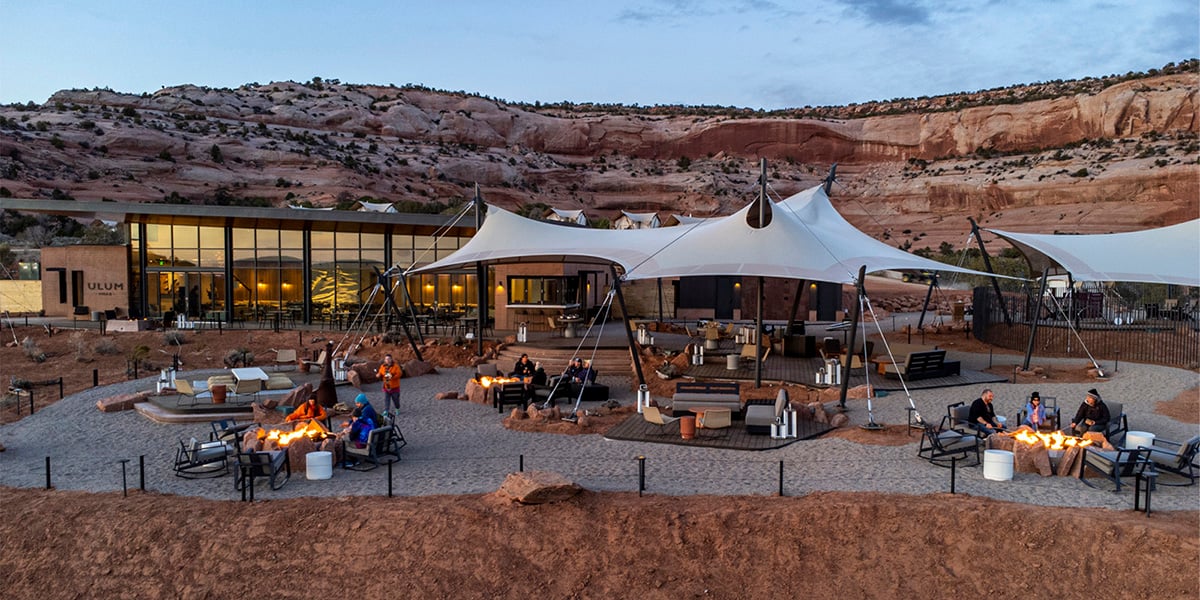
The site selection for ULUM Moab is not incidental — it is the argument. The 200-acre desert property is positioned south of Moab, Utah, surrounded on three sides by 100-foot sandstone cliffs and opening to expansive views across Canyonlands National Park. Steps from the property is Looking Glass Rock — an exceptional natural rock arch that served as both the focal point around which the property was designed and a natural landmark visible from the lobby, the dining terrace, and many of the suite tent decks.
Moab is a destination that already attracts a sophisticated, adventure-motivated, high-spending traveller: the mountain biking community, the national park enthusiast, the road-tripper who plans their entire itinerary around Arches and Canyonlands. These guests were, before ULUM, spending their nights in Moab's existing hotel inventory — which was not designed for them. ULUM offered them something that did not exist: a five-star hospitality experience embedded directly in the landscape they had come to experience, with no buffer between the guest and the desert.
ULUM Moab comprises 50 suite tents, each 360 square feet of interior space with a private 70 square foot deck. The interiors are designed to the standard of a luxury boutique hotel: king beds with heated mattress pads, plush Parachute linens, custom branded robes, queen-size sofa beds for additional sleeping capacity, lounge chairs, and bedside tables topped with lanterns. Each suite has an ensuite bathroom with a rain shower and a polished concrete sink. Evaporative coolers manage the desert heat in summer; wood-burning stoves warm the tents in the cool desert evenings of spring and autumn.
The material language throughout the property is rooted in the local landscape. Polished concrete, local stone, natural wood, and thermally modified lumber are used consistently across built elements. The lobby's chandelier — a custom piece crafted from semi-translucent smoky quartzite fragments arranged with a sense of organic levitation — was made from ancient rock fragments sourced from the site itself. A floor-to-ceiling sculptural wall reinterprets the surrounding sandstone cliffs. The design, led by VP of design Ben Landry and senior project designer Jennifer Kreisberg, was built around a single instruction: make materials that feel and look comfortable, yet can be easily cleaned as guests come in from hikes and mountain biking.
Beyond the tents, the communal infrastructure at ULUM sets it apart from any previous outdoor hospitality product. The contemporary lobby flows without interruption from lounge to dining area to alfresco terrace to yoga deck. Three dipping pools — including a hot pool and a cool pool — face Looking Glass Arch. Fire pits and intimate gathering areas are distributed across the terraced outdoor space. The café brings specialty espresso, fresh juice, and smoothies to the outdoor environment. The full-service restaurant serves al fresco, using a seasonal menu built around southwest-inspired flavours and sustainable ingredients, complemented by craft cocktails featuring sage, juniper, and prickly pear.
At ULUM, complimentary programming is available throughout each day: guided yoga sessions, nightly stargazing, on-site hiking, live acoustic music in the evenings, and the ceremonial burning of white copal — a natural Mayan resin — each morning in the communal area, greeting the rising sun and creating space for reflection. These are not amenity extras. They are structural features of the daily rhythm of a ULUM stay, designed to make the experience feel like something guests inhabit rather than consume.
For off-site adventures, ULUM's Adventure Concierge connects guests with trusted local outfitters: world-class white water rafting on the Colorado River, technical rock climbing at Looking Glass Arch directly adjacent to the property, guided national park tours through Canyonlands and Arches, canyoneering, horseback riding, and luxury river float trips. The Adventure Concierge model — curated third-party experiences integrated into the ULUM booking and guest service infrastructure — allows the brand to offer a full adventure portfolio without owning or operating any of the activity providers directly.
One of the most instructive aspects of ULUM's product strategy is its use of brand partnerships to define the experience without requiring ULUM to build every element from scratch. Aesop provides the bath and skincare products in every suite — a brand association that communicates a specific aesthetic and quality register to a guest who is already familiar with Aesop's positioning. Parachute supplies the ULUM-branded Turkish cotton robes. Vuori performance apparel is available on-site for purchase. Rivian Waypoints Level 2 EV chargers are installed at the property, connecting the brand to the most visible vehicle of the sustainable adventure lifestyle.
Each of these partnerships is functionally a guest experience decision: the guest who encounters Aesop toiletries at ULUM has the same emotional response to that discovery as they would in a five-star urban hotel. The brand signal is identical. The difference is that they are having that experience in a tent, in the Utah desert, looking at a rock arch through their tent flap. The juxtaposition is the product.
ULUM Moab was built with a stated commitment to sustainability that is embedded in the physical infrastructure rather than described only in communications. The property follows International Dark Sky principles — all lighting is designed to minimise light pollution and maximise the night sky experience. The Nature Conservancy is ULUM's conservation partner, with guests invited to contribute to conservation research and community education programmes. The materials used throughout the property — thermally modified lumber, recycled paperboard walls, carbon-sequestration basins and sinks — were chosen for both their aesthetic and their environmental performance.
ULUM proves two things simultaneously. First: that the market for ultra-luxury outdoor hospitality is real and commercially viable — that there is a guest who will pay five-star rates for a tent in the right location if the product and service meet five-star standards. Second: that the most effective way for a market leader to capture an emerging premium segment is not to stretch the existing brand upward, but to create a new brand that can inhabit that segment with full conviction, unencumbered by the positioning constraints of its predecessor.
All images are the property of their respective owners and are used for editorial and illustrative purposes only. Image rights belong to the featured brands and their designated photographers. AWAYO® makes no claim of ownership over third-party imagery.