

We’d love to hear from you — whether you have a project in mind, or just want to say hello.
hello@awayo.co
.svg)
Kjartan was a shy Norwegian electrician who had fallen in love with a girl from Sydney, Australia. At some point — nobody seems entirely sure when, or whether he fully believed it himself — he made her a promise. If I ever marry that girl, he said, I will build her a treehouse to propose in. He kept his promise. High in the branches of a tall pine tree, ten metres above the ground, he built her a treehouse. Simple, rustic, accessible only by climbing the tree itself. In it, he proposed. She said yes.
And somewhere in the happiness of that moment, something else happened: Kjartan and Sally — now Kjartan and Sally Aano — began to understand that what they had created in those branches wasn't just a memory. It was the beginning of something. That first treehouse, unsafe by any professional standard and extraordinary by every human one, sparked a question: what if others could experience this? What if the feeling of being held by a forest, suspended above the world, away from everything — what if that could be made available, properly, to anyone who needed it? This is how Woodnest was born.
Our vision is to create a place where people can disconnect from daily life and reconnect with nature. True luxury lies in simplicity, slowing down, and being present. — Kjartan, Founder, Woodnest
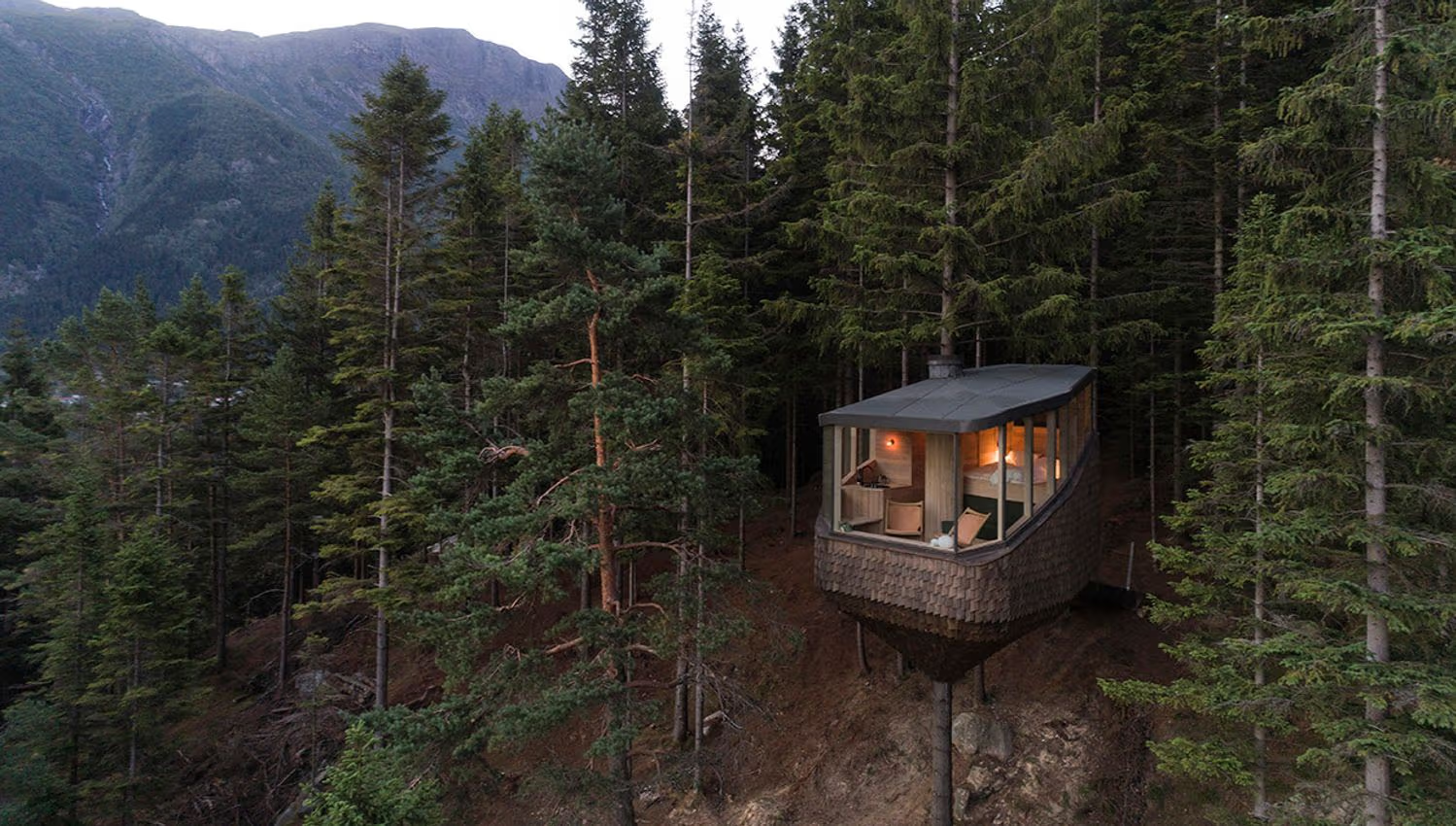
To realise the idea properly, Kjartan and Sally commissioned the Norwegian architecture studio Helen & Hard. Each treehouse is anchored to a single living pine tree using a steel collar — a structural ring that embraces the trunk without compressing or damaging it, allowing the tree to continue growing naturally while bearing the full load of the structure above. The collars are engineered to expand with the tree over time. The forest floor beneath each cabin remains entirely untouched. No foundations were sunk into the earth. No concrete was poured. The entire structure hovers, suspended in the canopy.
The construction presented its own remarkable logistics challenge. The site is accessible only on foot — a steep, winding 20-minute hike through dense forest from the town of Odda. There is no road. The large structural elements were transported to the site by helicopter. The smaller tools and materials came up in backpacks, carried by fit hikers. Every component of the building arrived either through the air or on someone's back.
Our aim was to create a space that truly embodies what it means to dwell in nature. The architecture sits quietly in an extraordinary situation — inviting people to pause, and notice. — Helen & Hard, Architects
The external form of each Woodnest treehouse is immediate and memorable: a rounded, organic shell clad entirely in untreated timber shingles that echo the pattern of fish scales or, more precisely, the overlapping layers of a pinecone. The material choice is deliberate — untreated timber weathers and greens over time, gradually absorbing the colour of its surroundings until the cabin becomes progressively harder to distinguish from the forest itself. The architecture is designed to age into invisibility.
Inside, the plan radiates outward from the central tree trunk in all directions. A series of glue-laminated timber ribs extend from the structural core, creating the internal geometry of the space. The sleeping area, bathroom, kitchenette, and living space are arranged concentrically around the trunk — you are always, in every room, aware of the living tree at the centre of the structure. Panoramic windows ring the treehouse on all sides. On one face, the view opens into dense pine canopy. On the other, the view drops away to the Sørfjord below. The guest is neither inside the forest nor outside it. They inhabit both at once.
One of the decisions that most defines the Woodnest experience is the deliberate inaccessibility of the site. There is no car access. There is no lift. The only way to reach Woodnest is on foot, up a steep forest trail from Odda — 160 to 225 metres of total ascent over a distance of 320 to 640 metres. The hike takes between 20 and 60 minutes, depending on fitness and conditions. The exact location is kept secret until check-in.
This is not a limitation that the founders apologise for. It is a feature that they explain carefully and position as the beginning of the experience. The hike is a threshold — the physical enactment of leaving ordinary life behind. Stone steps carved into the mountainside. A steep wooden staircase ascending through pine canopy. Then, at last, a small timber footbridge leading off the path and directly into the front door of the treehouse. By the time guests arrive, they have already been changed by the journey. The treehouse doesn't have to do everything. The mountain has done half the work.
Woodnest is four treehouses. It is a family business. No corporate layer between the founders and the people who stay in their treehouses. A waiting list. And one of the most recognisable outdoor hospitality experiences in the world — not because of marketing, but because of the originality and honesty of the idea behind it.
All images are the property of their respective owners and are used for editorial and illustrative purposes only. Image rights belong to the featured brands and their designated photographers. AWAYO® makes no claim of ownership over third-party imagery.