

We’d love to hear from you — whether you have a project in mind, or just want to say hello.
hello@awayo.co
.svg)
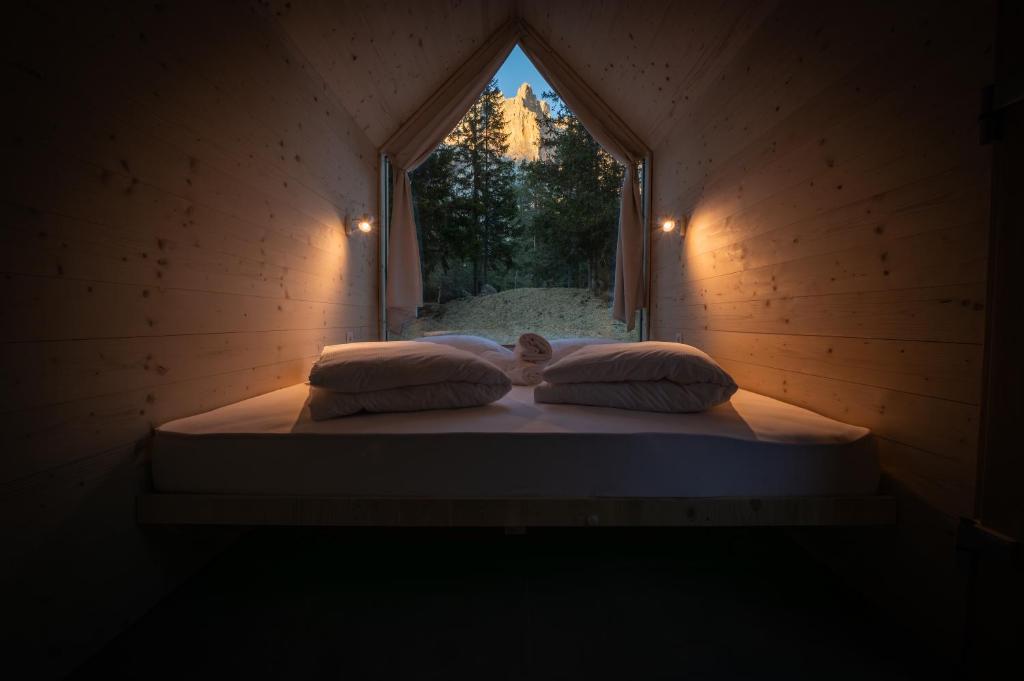
Camping Sass Dlacia, part of the Sass Dlacia family enterprise in San Cassiano, Alta Badia, is worth studying — not just as a place to spend the night, but as a business case in what happens when a campsite stops thinking like a campsite.
Alta Badia is one of the most sought-after alpine destinations in Europe. It sits within the Dolomiti Superski area — the largest interconnected ski region in the world — and draws a consistent, high-spending international clientele year-round. Hikers in summer, skiers in winter, and a growing number of travellers who come specifically for the landscape, the food, and the Ladin culture in between.
Sass Dlacia sits 1.5 km from the first ski lift, with a free ski bus connection. Cross-country trails begin at the entrance gate. The Falzarego Pass and Cortina d'Ampezzo are within easy reach. In outdoor hospitality, location is everything — and Sass Dlacia has one of the best in the Alps. The question is always what you do with it.
What makes Sass Dlacia genuinely interesting from a business perspective is the deliberate diversification of its revenue structure. It is no longer a campsite with pitches and a basic sanitary block. It is a layered hospitality operation running six distinct accommodation formats simultaneously:
Traditional pitches for tents, vans, and motorhomes. Rooms with kitchenette and private bathroom. The Sass Dlacia Lodge — a 60m² chalet for up to five people across two floors. A-Frame Cabins for two, positioned as design-led glamping units with shared facilities. Forest Cabins — Lushna units from Slovenia, introduced in 2024, with private bathroom and kitchenette, and that distinctive glass rear wall. And Les Üties — simple wooden huts for hikers and climbers, available in summer only, at the budget end of the spectrum.
This is smart inventory management. Entry-level pitches from around €35 per night capture price-sensitive travellers and vanlifers. Forest Cabins and the Lodge convert high-intent guests into significantly higher ADR bookings. Every format serves a different guest profile — and all of them share the same fixed infrastructure cost base.
Layered on top: the Natura Wellness Centre, with Finnish sauna, bio sauna, and steam room. A full restaurant serving traditional Tyrolean and Ladin cuisine. A wood-fired pizzeria. A café bar. Breakfast service. Equipment rental — bikes, climbing gear, snowshoes. And a small on-site minimarket with fair-trade and organic products.
The result is a guest who arrives for two nights and stays for five, spending money at every touchpoint along the way.
One move stands out as a deliberate strategic bet. In 2024, Sass Dlacia added the Lushna Forest Cabins — prefabricated glamping units manufactured in Slovenia, designed with a full glass rear panel that turns the Dolomite peaks into the back wall of the room.
This is the AWAYO® model playing out in the real world. A modular, transportable structure with minimal site preparation. High visual impact. Strong social media appeal. A premium price point justified by design and location rather than square metres. Reviews confirm the strategy is working — guests consistently call the cabins a highlight, separate from the landscape itself.
The investment was modest compared to traditional construction. The return is a new guest segment — design-conscious travellers who would never have booked a traditional pitch, but will pay a significant premium for a well-executed cabin in a world-class location.
Most alpine campsites close for six months of the year. Sass Dlacia operates two full seasons — winter from December to April, summer from late May to early October — with only a brief closure in between.
This changes the entire unit economics of the business. Fixed costs — staff, infrastructure, maintenance — are spread across a much longer revenue window. The ski-adjacent location makes winter viable in a way that most European camping operations simply cannot replicate.
It also means the brand stays active in the minds of guests year-round. A family that camps in summer returns in winter on skis. A couple in a Forest Cabin in July books the Lodge for Christmas week.
The campsite-to-destination transition is one of the most significant commercial opportunities in European outdoor hospitality right now. Most operators have the land. Most have the location. Few have made the deliberate decision to layer product tiers, invest in design-forward accommodation formats, and build the ancillary revenue streams that turn a night's sleep into a full guest experience.
Sass Dlacia doesn't do anything that couldn't be replicated — and that's precisely the point. The Lushna cabins are available to any operator willing to invest in them. The wellness centre logic applies to any site with shower blocks that could be upgraded. The F&B stack — breakfast, restaurant, pizzeria, bar — works at any destination that already has guests on site.
What Sass Dlacia has done is make the decision to stop competing on price per pitch and start competing on experience per stay. That shift in thinking is the hardest part. The rest is execution.
We look at operations like Sass Dlacia and see the blueprint for what outdoor hospitality should become across the Alps. Not because it's perfect — there is more to do on digital experience, direct booking strategy, and brand storytelling. But because it proves the model works.
Camping Sass Dlacia is located in San Cassiano, Alta Badia, South Tyrol, Italy. Open December–April and May–October. campingsassdlacia.it
All images are the property of their respective owners and are used for editorial and illustrative purposes only. Image rights belong to the featured brands and their designated photographers. AWAYO® makes no claim of ownership over third-party imagery.