

We’d love to hear from you — whether you have a project in mind, or just want to say hello.
hello@awayo.co

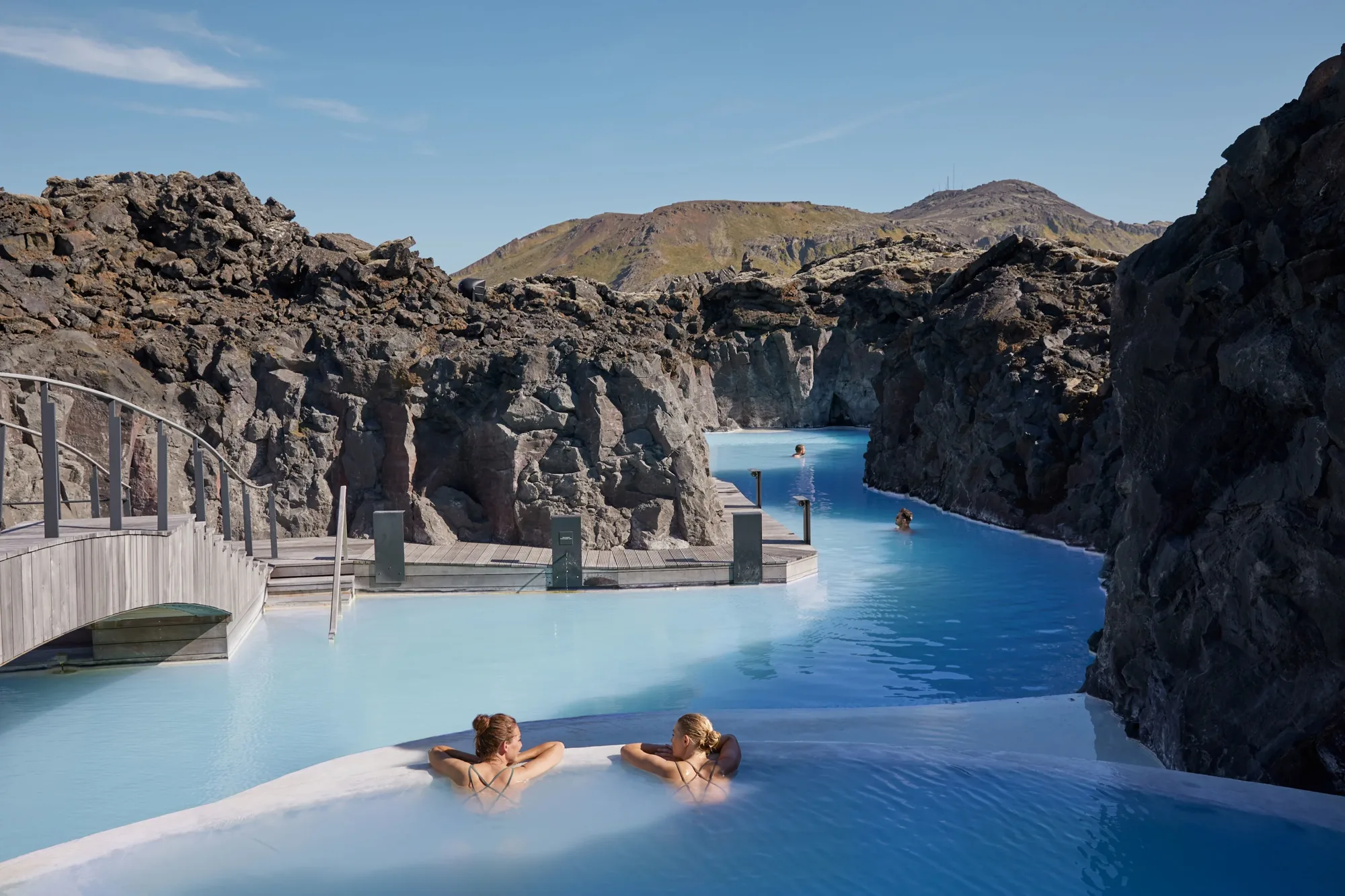
Warm water, black lava, open sky — the asset the market almost overlooked. The Retreat Lagoon at Blue Lagoon Iceland. Photo: Blue Lagoon Iceland.
On November 18, Anthropic priced the largest IPO in history. It sold 980 million shares at $83 each — above its own range of $70 to $78. That is roughly $81 billion in fresh capital, for a company reported to be worth more than $2 trillion.
Two days later, in Reykjavík, Blue Lagoon Corp. listed on Nasdaq Iceland under the ticker BLUE. It sold 150 million new shares at ISK 95 each. Gross proceeds: ISK 14.25 billion — about $115 million. Post-offering market value: roughly $790 million.
Put the two side by side and the ratio is almost absurd. For every dollar raised by one of the world's best-known experiential destinations, the market raised around 700 dollars for intelligence.
This report is not about whether Anthropic is worth it. It is about what the other number tells us.
The gap is not a one-off. It is the shape of the market.
In 2025, AI companies took 61% of all global venture capital — $258.7 billion out of $427.1 billion. In 2022, the share was 30%. In the first quarter of 2026 it reached roughly 80%, and four deals alone accounted for about two-thirds of everything invested worldwide.
When four out of five venture dollars chase one theme, the rest of the economy is not being evaluated. It is being ignored. That is not a judgement on AI. It is an observation about mispricing — and mispricing is where good investments come from.
Capital follows what can scale. Value hides in what can't.
Every economic revolution makes something abundant — and something else scarce. Industrialisation made goods cheap and time valuable. The internet made information free and attention expensive.
AI is making intelligence abundant. Writing, analysis, images, advice — all of it is heading towards a marginal cost close to zero. What it cannot produce is the opposite: a body in warm water, a cold night under a clear sky, a valley you reach in an afternoon and remember for years. Compute scales. A lava field doesn't.
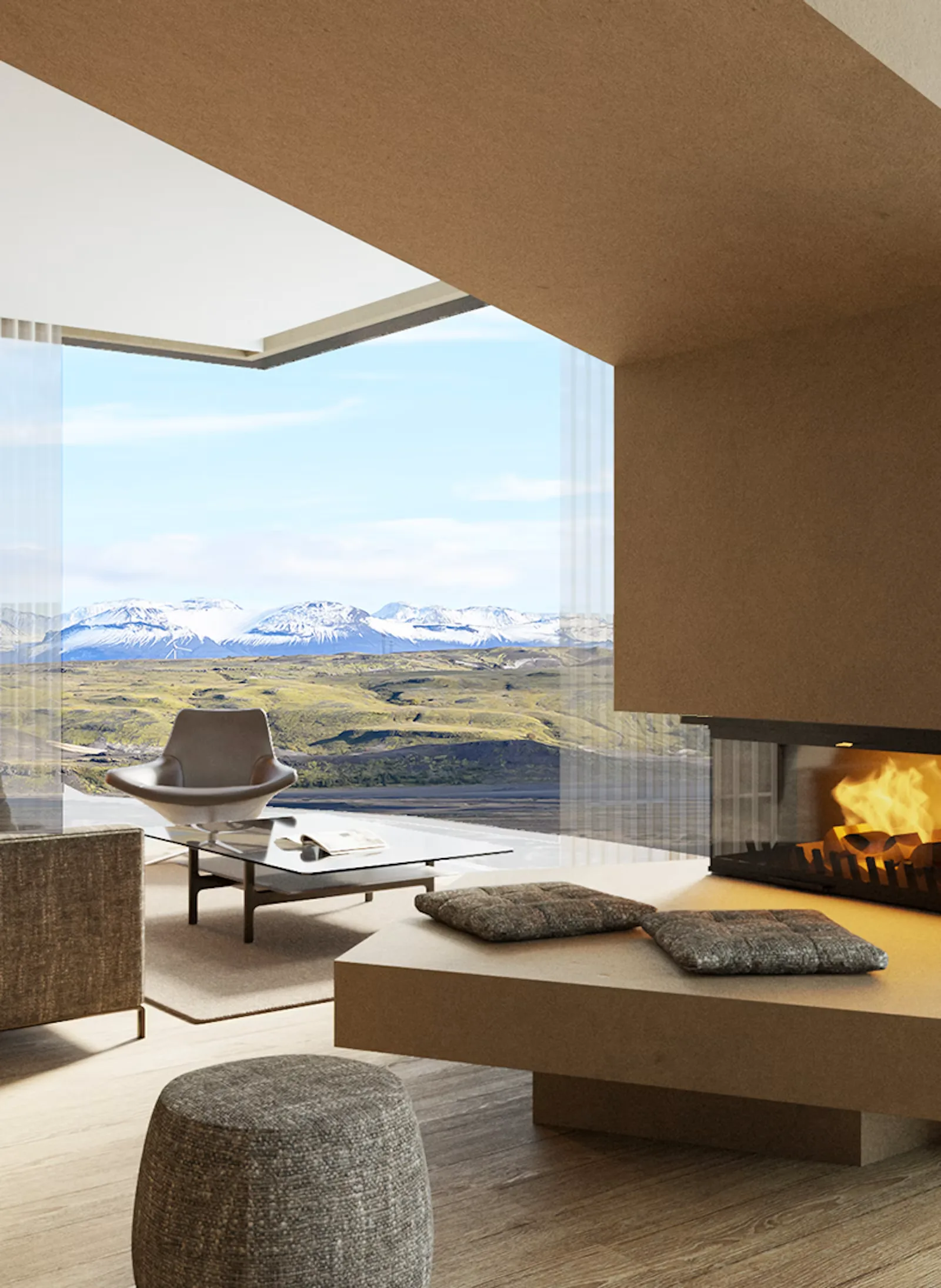
Fire, stone, a mountain range — nothing here can be generated. Suite lounge, Mountain Retreat. Rendering: Blue Lagoon / Þjórsárdalur.
The demand side has already noticed:
→ The global wellness economy reached $7.5 trillion in 2025, up 8.9% in a year — faster than the economy as a whole.
→ Thermal and mineral springs grew 10.4%, with close to 10% annual growth forecast through 2030.
→ Rest comes first. In Hilton's 2026 trends survey of more than 14,000 travellers, rest and recharging was the number one reason to travel (56%). Time in nature followed (37%).
→ Screens are losing. 77% of respondents in one 2026 outdoor survey said they had already cut their screen time.
→ Search follows. Searches for "detox retreats" rose 89% in a year; "forest bathing" rose 79%.
The more of our day runs through a screen, the more we pay for the hours that don't. Wellness and experiential hospitality are not a side story to the AI era. They are its counterweight.
Intelligence scales with compute. Presence scales with nothing but place.
Blue Lagoon began in 1992 as a research company studying the water of a lagoon formed by a geothermal power plant. Today it is a group of spas, hotels, restaurants, skincare and — with the acquisition of Arctic Adventures — guided tours. "Wellness is the new luxury," CEO Sigríður Margrét Oddsdóttir told CNBC in listing week.
The figures from the IPO prospectus and investor presentation:
→ Revenue growth 2015–2025: 11% per year on average
→ Revenue 2025: €156m, EBITDA €29m
→ Revenue 2027E (incl. Arctic Adventures): €291m
→ EBITDA 2027E (incl. Arctic Adventures): €72m
→ Guests and customers per year (group): ~3.2 million
→ Share of revenue among Iceland's 10 largest lagoon operators (2024): 54%
→ Enterprise value at offer price: €926m
→ EV / EBITDA 2027E: 12.8x
→ Peer average / integrated destinations: 15.8x / 18.9x
Read the last three lines again. A business with a site that cannot be copied, double-digit growth for a decade and more than half of revenue among Iceland's largest lagoon operators came to the public market at a discount to its peers — and well below the multiples paid for integrated destinations.
A place that cannot be copied, priced below its peers. That is not a valuation. That is an opening.
The guests understand the counterweight. Capital, so far, does not.
Where Blue Lagoon puts its IPO money says more than any multiple. The group's next flagship is Þjórsárdalur, a valley on the edge of the Highlands about 110 km from Reykjavík, marketed as Iceland's "Valley of Discovery".

Fjallaböðin, the Mountain Baths, with the Mountain Retreat suites stepped into the mountainside above. Opening 2028. Rendering: Blue Lagoon / Þjórsárdalur.
It is not a resort. It is a destination with a price point for every guest:
→ Campsite. Tents and caravans at the valley entrance. Planned.
→ Cabin. 58 m², five bunk beds for up to 10 guests, bring your own sleeping bag. Summer 2027.
→ Lodge. 47 m², one bedroom, 2–4 guests, full kitchen. Summer 2027.
→ Family lodge. 63 m², two bedrooms, 4–6 guests. Summer 2027.
→ Mountain Retreat. Hotel set into the mountainside, every suite with balcony and private lagoon. 2028.
→ Mountain Baths and Welcome House. Geothermal pools in the rock, restaurant, exhibition. 2028.
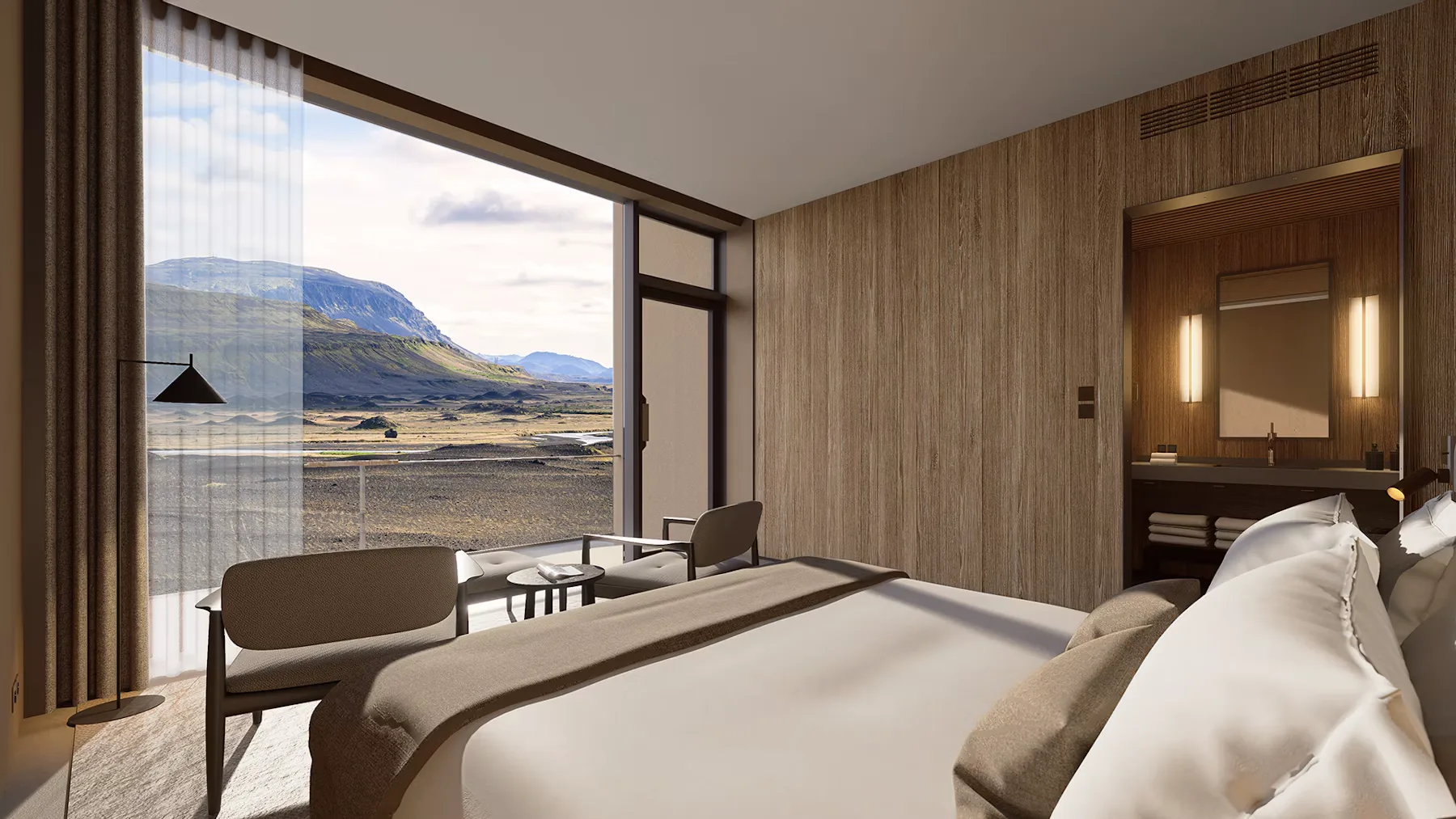
The top of the spectrum: a Mountain Retreat suite opening onto Þjórsárdalur. Rendering: Blue Lagoon / Þjórsárdalur.
Three things stand out. The baths are the gravity — everything else is positioned around them. The 40 lodges and cabins open a year before the hotel, so the valley earns before the flagship is finished. And the whole spectrum, from sleeping bag to private lagoon, shares one arrival, one story and one landscape.
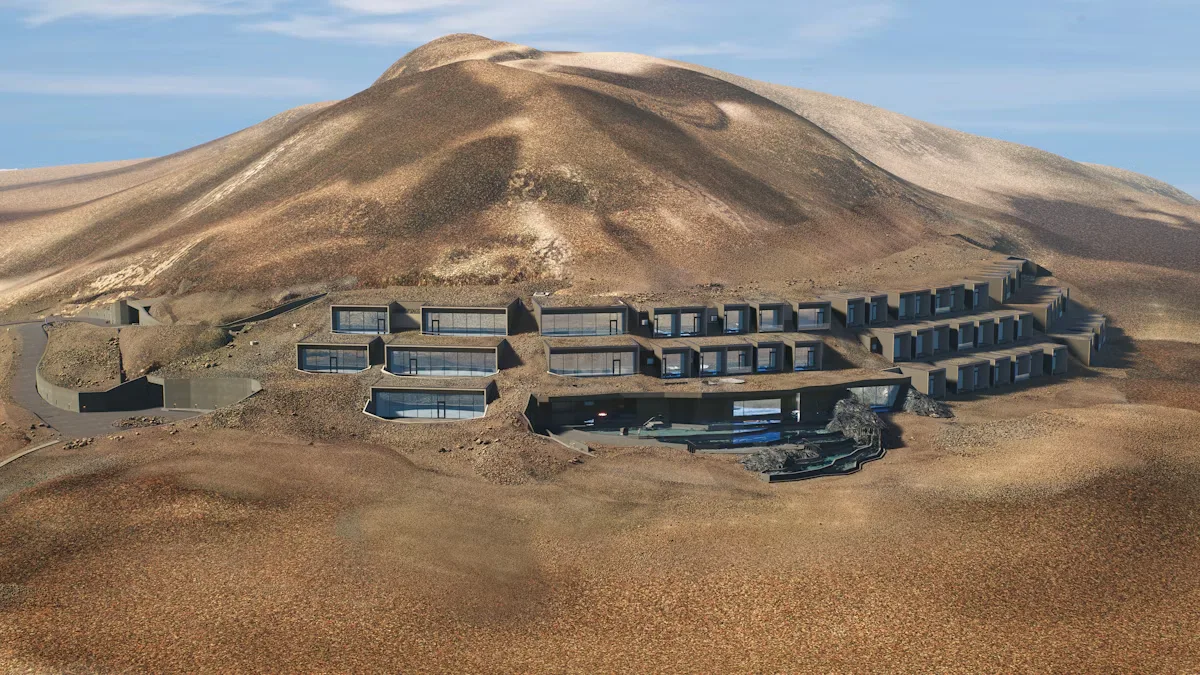
A hotel that disappears into a mountain: the Mountain Retreat and Mountain Baths in Þjórsárdalur, opening 2028. Rendering: Blue Lagoon / Þjórsárdalur.
The numbers behind it: a total investment of €139m, of which €71m was already spent by the end of Q3 2026. At full capacity the company expects €64–70m in revenue at a 30–35% EBITDA margin, roughly four years after opening.
That implies €19–25m of EBITDA on €139m of capital — built at roughly 6–7x EBITDA, inside a group the market values at almost 13x. Our calculation, at full ramp-up. The spread between what a place costs to build and what it is worth once it works is the whole investment case for experiential hospitality.
Built at six to seven times EBITDA. Valued at thirteen. The spread is the business model.
Camping is already Europe's quiet growth story. In 2025, the EU recorded 413 million nights at campsites and RV parks — up 28.5% since 2015, ahead of hotels at 23.4%. But two-thirds of those nights fall between June and August. The segment grows, but it still lives off one season.
Wellness is the lever that breaks that pattern. Warm water works in November. A sauna is better in snow. Blue Lagoon sells a summer product all year round.
The industry has started to respond. In France, a five-star campsite now almost always comes with a heated indoor pool, sauna, hammam, jacuzzi and treatment rooms. Elsewhere, camping lodges arrive with their own private sauna and hot tub. Useful — but mostly amenities added to an existing site, not a concept built around one.
The Icelandic playbook suggests five moves for camping chains:
→ 1. Anchor before amenity. In Þjórsárdalur the baths are the reason to come; everything else is arranged around them. A spa next to the reception is a facility. A signature water, sauna or landscape experience is a destination.
→ 2. Own the whole spectrum on one site. Chains already own the pitch. Add cabins, lodges and a few premium units around the same anchor, and the site serves the sleeping bag and the private lagoon at once — with a higher average spend and the same arrival.
→ 3. Sequence the build. Open the units first and let them carry the cash flow while the flagship is built. Blue Lagoon opens its cabins a year before the hotel.
→ 4. Sell the day, not just the night. The Blue Lagoon itself is a day-visitor business at its core. A campsite with a real bathing experience can sell day passes to people who never stay overnight.
→ 5. Get valued as a destination. A campsite is usually priced on land and pitches. An integrated destination is priced on its earnings power — at 12.8x to 18.9x EBITDA in the Blue Lagoon comparison. The concept is what moves an asset from one category to the other.
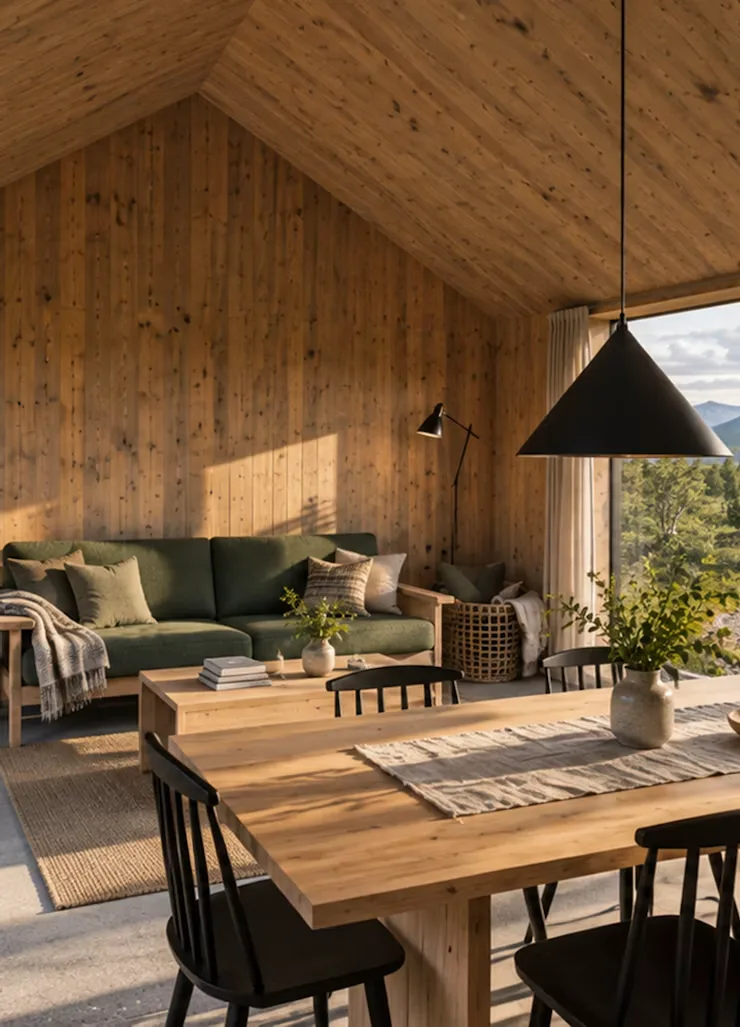
The middle of the spectrum: a cabin that turns a pitch into a stay. Rendering: Blue Lagoon / Þjórsárdalur.
Camping doesn't need more amenities. It needs a reason to come in November.
For the consolidators we have covered in this series — from WeCamp to Collection Rivages — the question is no longer whether to add wellness. It is whether to keep bolting it on, or to start building sites around it.
None of this makes AI the enemy. For operators, it is a tool — we argued as much in The Intelligent Retreat. Let software run pricing, staffing and guest communication, and people are freed for the part no machine can deliver.
For the guest, though, the logic runs the other way. The more intelligent everyday life becomes, the more valuable the places where nothing needs to be optimised. That is the counterweight. And it is still priced like a niche.
The $81 billion went to intelligence. The opportunity sits in land, landscape and concept — in places that cannot be downloaded, replicated or scaled by compute. Blue Lagoon has spent 34 years proving that such a place can become a listed company. Þjórsárdalur shows how the next one gets built: anchor, spectrum, sequence.
Europe has hundreds of valleys, lakes and mountainsides waiting for that playbook. What Soho House did for the city — we're doing for nature.
The $81 billion bought intelligence. The next decade of value will be built in places that cannot be generated. That is the whole opportunity in experiential hospitality, compressed into one word: presence.
AT A GLANCE
Anthropic IPO: 980M shares at $83 (range $70–78) · ~$81bn raised (our calculation)
Blue Lagoon IPO: 150M new shares at ISK 95 · ISK 14.25bn (~$115m) raised · ~4,000 subscriptions
AI share of global venture capital: 30% (2022) · 61% (2025) · ~80% (Q1 2026)
Global wellness economy: $7.5tn (2025, +8.9%) · thermal and mineral springs +10.4%
Blue Lagoon: revenue €156m (2025) · €291m pro forma (2027E) · 11% CAGR 2015–2025 · ~3.2M guests and customers
Valuation: EV €926m · 12.8x EBITDA 2027E vs. 15.8x peers · 18.9x integrated destinations
Þjórsárdalur: €139m investment · 40 lodges and cabins (47–63 m²) from summer 2027 · Mountain Retreat and Mountain Baths 2028 · €64–70m revenue at maturity, 30–35% EBITDA margin
EU camping nights: 413M (2025) · +28.5% since 2015 vs. +23.4% hotels · 67% in June–August
Source: Blue Lagoon Corp. investor presentation and prospectus (November 2026), Landsbankinn, Reuters, CNBC, OECD, Crunchbase, Global Wellness Institute, Eurostat, thjorsardalur.is. Cross-references to AWAYO® Special Field Report No. 03 (four-season Alps) and the Best Practice Series where noted.
Image credits & disclaimer: Hero photo © Blue Lagoon Iceland. Renderings of the Mountain Retreat, Mountain Baths and Þjórsárdalur © Blue Lagoon / Þjórsárdalur. Renderings are visualisations of projects under development; final design, materials and details may differ. All images are used for editorial commentary only; all rights remain with their respective owners. AWAYO® is not affiliated with Blue Lagoon Corp. or Anthropic. Rights holders who wish an image to be removed or credited differently can contact hello@awayo.co. All information provided is without guarantee and subject to change without notice.