We’d love to hear from you — whether you have a project in mind, or just want to say hello.
hello@awayo.co
.svg)
Uniresorts was built on the premise that this model is broken — and that something better was possible.
In 2020, nature tourism entrepreneur Kari Vainio and Helsinki-based architecture firm Studio Puisto completed the first Uni Villa prototype at Kytäjä Golf in Hyvinkää, Finland. The project was the result of a shared frustration: both parties had spent years working in and around outdoor hospitality and had watched promising operators fail not because their concepts were weak, but because the path from idea to opening was too costly and too complex to navigate.
Their response was to design the solution themselves — and then offer it to others.
Studio Puisto, founded in 2010 and whose name translates simply as "park" in Finnish, had already built a reputation for contextual, ecologically grounded architecture with projects ranging from the Arctic TreeHouse Hotel in Rovaniemi to the floating Piilokoju birdwatching hut. The firm's approach is consistent across every scale: nature first, object second. Buildings adapt to their sites, not the other way around.
Vainio brought the operator's perspective — years of running Naava Villas, Naava Resort, and Naava Chalet had given him a precise understanding of where hospitality concepts succeed and where they quietly die. His diagnosis was clear: the failure point is almost never the guest experience. It is the gap between vision and viable execution.
Together, they set out to close that gap.
The concept: uni as a system, not a product
The name Uni is the Finnish word for dream — a deliberate nod to the aspirations of the entrepreneurs the concept was designed to serve. But the product itself is anything but abstract.
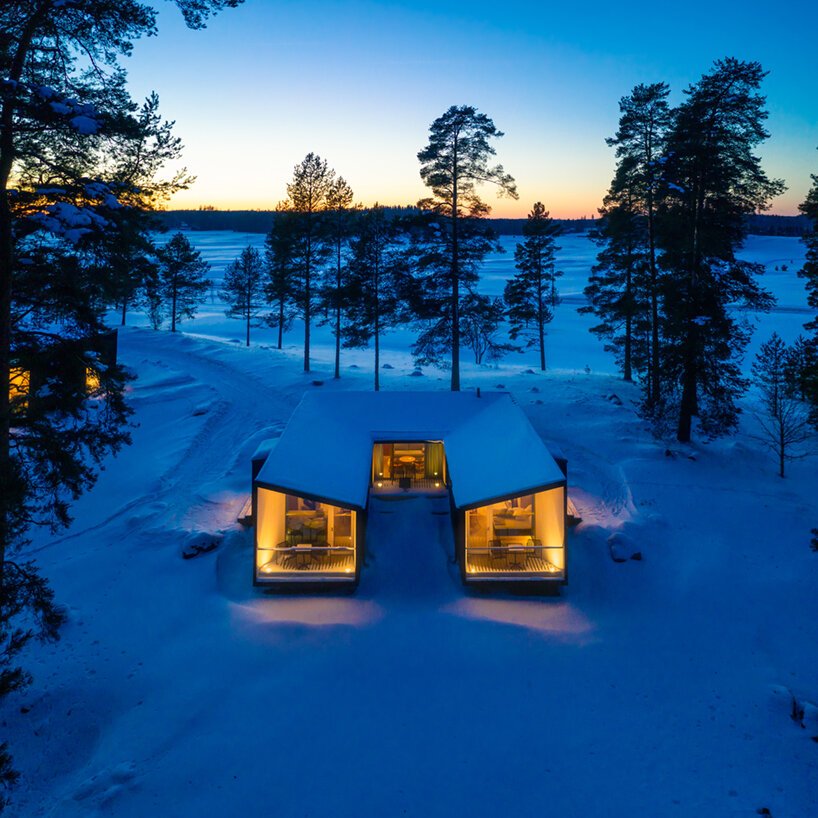
Each Uni Villa is a modular, U-shaped structure built from cross-laminated timber (CLT), prefabricated entirely off-site and sized precisely to fit on the back of a standard truck. This is not incidental. The truck constraint is a design principle. It means the unit can reach almost any location in the world — a golf course, a forest edge, a lakeside — without requiring heavy construction equipment, extended on-site build time, or significant ground disruption.
Each module contains three accommodation units: two studios and one suite. The spatial distinction is deliberate. Studios deliver a light, fresh atmosphere with neutral tones — accessible, versatile, suited to couples and solo travellers. The suite turns darker, wrapping guests in warm tones and sensory-rich textiles that create a different emotional register within the same footprint. Both types share a design language anchored in woollen textiles, natural materials, indirect lighting, and a finish quality that sits well above what the square footage suggests.
Every detail is pre-considered. Ready-made furniture is included. The check-in system is keyless and automated. The foundation is versatile enough to suit remote and uneven terrain. Three Uni Villa modules together form a micro-resort of nine units — complete, operational, and financially viable as a standalone hospitality business.
What distinguishes Uniresorts from a standard prefab cabin supplier is the ambition behind the product. The goal was never simply to sell modular units. It was to productise the entire path from concept to operating business — and to do so in a way that made the economics work for operators who are not major hotel groups.
The Uniresorts operating model addresses what the founding team identified as the real barrier to entry in nature hospitality: not the desire to build, but the knowledge and capital required to do it correctly. The average daily rate, occupancy assumptions, initial capital investment, and fixed operating costs are all built into the model before a site is selected. By the time an operator commits, the financial case has already been stress-tested.
Technology is embedded from the start rather than bolted on afterwards. Keyless locks, automated guest communications, and remote-controlled building systems reduce the staffing requirement and make daily operations manageable at small scale. A three-module Uni Villa resort does not require a full-time maintenance team. It requires a well-designed system — and that system is part of what Uniresorts delivers.
The pilot at Kytäjä Golf — one of the most celebrated golf destinations in Finland, awarded best in the country in 2020 — provided both proof of concept and a prestigious first reference. Three modules installed in the forest adjacent to the fairways, serving a clientele of golfers, families, and nature travellers who would previously have had no accommodation option of this quality in the area.
To understand why the Uni Villa looks and feels the way it does, it helps to understand Studio Puisto's broader body of work. The firm's projects share a consistent set of values: minimum footprint, maximum integration with the landscape, and a material palette that prioritises ecological and tactile honesty over visual novelty.
The dark CLT exterior of the Uni Villa is not an aesthetic choice in isolation. It is a functional decision — the breathable ecological oil stain creates uniformity with the forest environment, allowing the structure to recede into its surroundings rather than announce itself. After dark, recessed spotlights wash gently over the exterior surfaces and indirect lighting inside highlights the texture of the materials. The building changes character between day and night without changing its form.
Inside, the approach is minimal by design but rich in sensory detail. The studio units read as light and spacious through pale wood tones and carefully considered proportions. The suite is more intimate, its darker palette creating a sense of enclosure and warmth. Both types avoid the trap that most budget-constrained hospitality projects fall into — the sense that cost-cutting has produced a sanitised, impersonal space. The Uni Villa interiors feel considered precisely because every element was designed as part of a system, not selected independently under budget pressure.
This is the compounding advantage of a purpose-built hospitality product over a bespoke one-off project: the design decisions have already been made and refined. The operator does not pay for the learning curve.
The Uniresorts model is worth studying not just as a product but as a structural argument about how outdoor hospitality should be built and scaled.
The conventional approach — commission an architect, find a contractor, manage a build, open — places enormous friction between intention and execution. Each stage introduces cost, delay, and the risk of decisions that undermine the economic viability of the final product. Most operators who navigate this process successfully are either very well capitalised or very experienced. Most who are neither fail quietly before they open.
Uniresorts removes that friction by design. The product is the process. The architecture, the unit economics, the operational technology, and the guest experience are integrated from the start rather than assembled in sequence. An operator who engages Uniresorts is not buying a cabin. They are buying an operating system for a nature hospitality business — tested, refined, and ready to install.
The ecological case reinforces the commercial one. CLT construction limits the environmental impact of the build. The compact foundation minimises ground disruption. The modular format means units can be relocated if a site's circumstances change. For operators working in or near protected natural areas — exactly the locations most in demand among the guests Uni Villas are designed to attract — this matters both as a planning argument and as a genuine expression of values.
The Uniresorts model is one of the clearest articulations of what we believe about the future of outdoor hospitality development. The insight at its core is simple but important: the barrier to entry in nature hospitality is not primarily capital. It is the absence of a proven, integrated system that makes a small-scale outdoor resort economically viable from the first unit.
What Studio Puisto and Kari Vainio built is not just a product. It is an argument that the relationship between architect and operator can be fundamentally different — that design and business logic do not have to be developed in sequence, but can be developed together, into something replicable and deployable at any site where the conditions are right.
That is exactly the direction outdoor hospitality needs to move. And Uniresorts is one of the most convincing demonstrations that it is already possible.
All images are the property of their respective owners and are used for editorial and illustrative purposes only. Image rights belong to the featured brands and their designated photographers. AWAYO® makes no claim of ownership over third-party imagery.