

We’d love to hear from you — whether you have a project in mind, or just want to say hello.
hello@awayo.co
.svg)
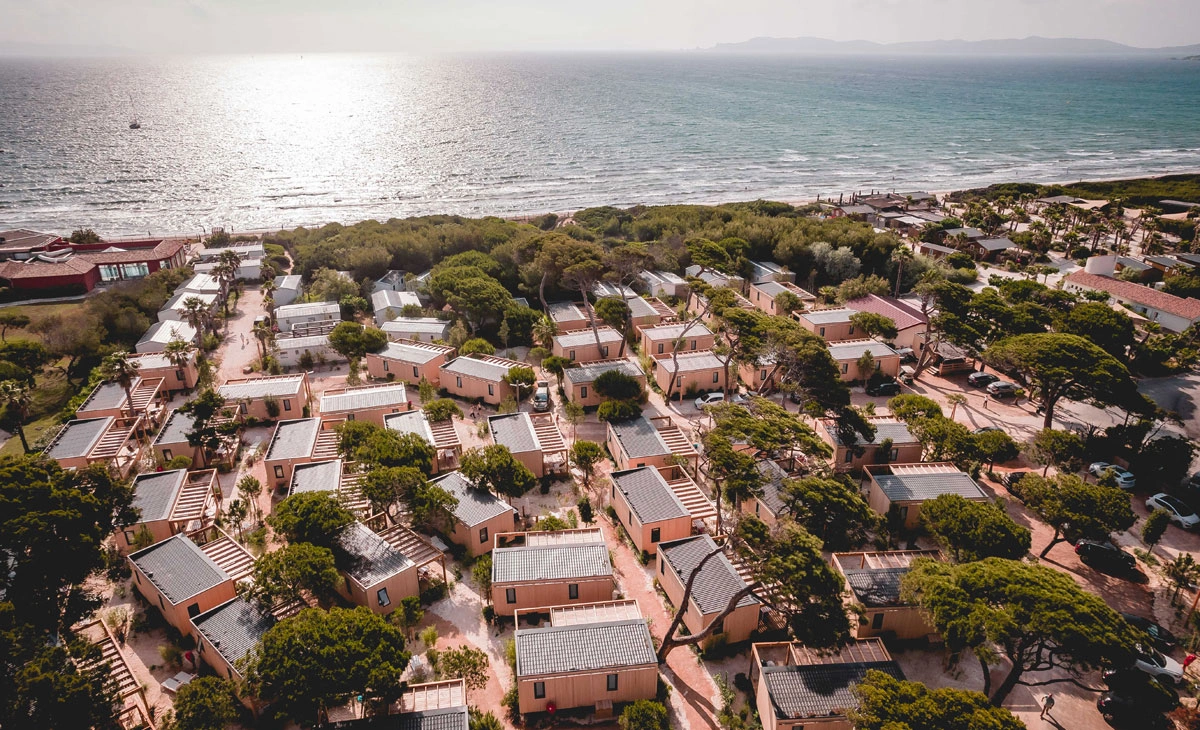
There is a quiet revolution happening in French outdoor hospitality, and it is not happening in the places you would expect.
It is not happening in new-build architectural landscape hotels in the Alps. It is not happening in canvas safari camps in the Camargue. It is happening on exactly the kind of sites most hospitality investors ignore — mid-life campgrounds, 40 to 60 years old, sitting on irreplaceable coastal and natural land across France, quietly losing money while the category around them transforms.
That is the category Collection Rivages has been systematically acquiring, redesigning and repositioning since 2022. Five sites today. A clear design system. A confident brand. A single booking engine. A mobile app. And a trajectory that makes them one of the most interesting case studies in European outdoor hospitality right now.
What they have built is not a camping chain. It is not a glamping operator. It is something new — and it deserves a proper look.
The most interesting hospitality operators in 2026 are not building on empty land. They are rebuilding on land that was already built on — and redefining what that land can be worth.
The narrative Collection Rivages tells about itself is instructive. On the brand surface, they speak of nearly 60 years of experience in outdoor hospitality. In reality, Collection Rivages as a brand was only founded in 2022. The 60 years refer to the family's roots in the campground sector — the generational know-how that informs how they operate today.
That distinction matters. Collection Rivages is a new brand built on old operational DNA. The founders didn't arrive as tourists in this industry. They grew up in it. They know how campgrounds actually run — the pinch points, the seasonal patterns, the operational quirks, the permitting landscape. And they have used that insider knowledge to do something most outsiders cannot: buy existing sites at rational prices, and reposition them with real conviction.
This is the first of several strategic advantages that makes the model work. Acquiring an existing, permitted, infrastructurally-serviced site is a fundamentally different exercise to greenfield development. The land use is already zoned. The water, sewage, power and access are already there. The seasonal operating rhythm is already understood. What needs to be changed is the product, the brand and the guest.
That is exactly what Collection Rivages changes. And that is where the work begins.
Collection Rivages currently operates five sites across France, each positioned at a premium coastal or riverside location:
Le Phare on the Île de Ré — the founding site, acquired and rebranded first, now the flagship.
Salines on the Presqu'île de Giens on the Côte d'Azur — pine forest, fine sand, direct access to the Mediterranean.
Sauvage on the wild coast of Quiberon in Brittany — Atlantic-facing, elemental, raw.
Rives d'Arc in the Ardèche gorges — inland river location, a counterweight to the coastal bias of the portfolio.
Les Maritimes near Hossegor in Les Landes — the newest addition, placed in the pine forest on the "Landifornia" surf coast.
What matters is not the individual sites. What matters is the system behind the system.
Every location sits on water. Every location is on land that is in most cases irreplaceable — either because the geography is unique or because the planning framework in that part of France would never permit a new site there today. Every location combines a natural setting with proximity to established French holiday infrastructure. And every location is being rebuilt around the same design language, the same guest philosophy, and the same operational backbone.
This is portfolio thinking applied to outdoor hospitality — and very few European operators are doing it this coherently.
The accommodation product at Collection Rivages is the visible tip of the strategy, and it is built around a deliberate rejection of the old campground mental model.
There are no mobile homes lined up in rows. There are no faded bungalows. There are no anonymous rentals with the generic french holiday-park feel. What there is instead is a curated range of architectural cabins, beach houses and so-called folies — signature units that each carry the brand's design handwriting.
Crucially, Collection Rivages describes its signature accommodations as conceived, designed and manufactured in France, in collaboration with artisan partners. That single operational decision carries enormous brand and asset implications. It means the product is proprietary. It cannot be directly copied. It is built to a quality specification that the brand controls from factory floor to final installation. And it ties the brand story directly into the French craft narrative that the target guest already responds to.
This is the same strategic move that Onera made in Texas with its hyper-designed micro-cabins, that Hilltop Forest made in Finland with its restraint-driven Nordic units, that hinter is making in Quebec with its carbon-negative modular program. A proprietary, brand-specific architectural product is not a nice-to-have in outdoor hospitality in 2026. It is the moat. Collection Rivages understood that early, and built around it.
In the new generation of outdoor hospitality, the accommodation is not a commodity rented out on a platform. It is the brand itself, manufactured and controlled.
The Collection Rivages brand position is one of the most precisely calibrated in European outdoor hospitality. It avoids almost every cliché the category is prone to.
It is not marketed as luxury — the word is almost entirely absent. It is not marketed as wellness. It is not marketed as wilderness adventure. It is marketed, instead, around the concept of the cabin as a shared family refuge — "une cabane à soi" — combined with a specifically French sense of good living, joy and ease. The tagline "where the good times light up as a family" (où le bon temps s'éclaire en famille) is not corporate filler. It is a positioning statement that tells you, as a prospective guest, exactly who the brand is for.
This matters economically because it solves a pricing problem that haunts the old French campground sector. Traditional campgrounds price on square metres and amenities — the size of the pitch, the proximity to the pool, the number of waterslides. Collection Rivages prices on emotional outcome. The guest is not buying a mobile home for a week. The guest is buying a specific version of a French family holiday that exists only at these addresses.
That reframing moves the asset out of the commoditised mass-market campground pricing grid and into an entirely different competitive set. Suddenly, the relevant comparison is not the campground down the road at 85 euros a night. It is the boutique family hotel at 280.
And the guest comes along.
What distinguishes Collection Rivages from most European outdoor hospitality operators is the quiet seriousness of its operational infrastructure.
There is a dedicated Collection Rivages app — available on iOS and Android — that lets guests book activities, discover local recommendations, access on-site services and communicate with the team. This is the kind of guest-layer tooling that most small outdoor operators either can't afford to build or don't know how to prioritise. Collection Rivages has made it a core part of the offer.
There is a unified direct booking engine that serves all five sites under one brand umbrella. There is a consistent website architecture across the portfolio, with individual property sites for each location that funnel into the central brand. There is a multilingual reservation flow — French, English, German, Dutch, Spanish — recognising that this is not just a domestic French product but a pan-European destination offer.
And there is a central brand team running integrated programming — from the Art Camp concept to events like Mojo Mojo to curated local guides — that creates reasons for guests to return, to book longer stays, and to bring others with them.
None of this is flashy. All of it is what an institutionally-investable hospitality platform actually looks like behind the scenes. And almost no small European outdoor operator has it.
Strip away the aesthetic layer and the operating model of Collection Rivages is remarkably disciplined.
They acquire rather than develop. Every Collection Rivages site was a functioning, permitted, serviced outdoor hospitality property before Collection Rivages got to it. The cost of entry is a multiple of revenue for a distressed or underperforming asset — a fraction of what greenfield development in the same locations would cost, if it were even permittable, which in most cases it no longer is.
They invest heavily in repositioning. The acquired site is not simply rebranded. It is comprehensively rebuilt — new accommodation product, new landscaping, new dining concept, new guest experience, new operational standards. This is capex-heavy work, but it is capex applied to an asset that already has planning consent and infrastructure. Every euro goes into the product the guest sees, not into the dirt they never will.
They standardise across the portfolio. The design system, the brand language, the booking infrastructure, the app, the operational playbook — all of it travels from site to site. That is what makes the model scalable. The fifth site costs less operational effort to onboard than the second. This is the same logic that has allowed AutoCamp, Postcard Cabins and Onera to move from single-site operators to platform businesses.
They operate as a family business with institutional discipline. This combination is rarer than it sounds. Most European outdoor hospitality is either mom-and-pop or institutional. Very few operators have successfully combined the cultural coherence of a family business with the operational sophistication of an institutional platform. Collection Rivages has.
For anyone watching the European outdoor hospitality category, Collection Rivages is important for three reasons that go well beyond the properties themselves.
First, it proves the repositioning thesis. Across Europe, and particularly in France, Italy, Spain, Austria and Germany, there is an enormous inventory of ageing campgrounds on irreplaceable land. Most of these sites are owner-operated, under-capitalised, under-branded and under-priced relative to what they could be. The thesis that there is more value in acquiring and repositioning these sites than in greenfield development has been debated in the sector for years. Collection Rivages has now demonstrated it operationally. That changes the capital allocation conversation.
Second, it reframes the campground as a premium asset. For two generations, the French campground was associated with volume, price sensitivity and a specific middle-class summer holiday pattern. Collection Rivages is proving that the same physical footprint — the same pine forest, the same beach access, the same river frontage — can support a premium brand at premium rates, provided the product, the operations and the guest are redefined together. This is not a trivial realisation. It is a revaluation of an entire asset class.
Third, it raises the bar on brand craft. What Collection Rivages has built on the brand side — the photography, the tone of voice, the app, the consistency across properties, the restraint, the confidence — is a standard that most small European outdoor operators are nowhere near meeting. That is not a criticism. It is a signal. Guests who stay at Collection Rivages will expect comparable polish at the next outdoor hospitality brand they book. The sector's baseline has moved.
All images © Collection Rivages. Used here for editorial and commentary purposes. AWAYO® holds no rights to the visual material.